A few years ago, while doing some business with the mighty Tokyo-based Wasabi Distro ( http://www.wasabi-distro.com/) I discovered Picaresque, a zine from Australia. I got issues #7 and #9 and I was hooked after reading one page. The idea behind the project is very simple: Brendan Rocks writes his memories, from his childhood to the present. The memories, though, are numbered, and distributed randomly, each one usually being only a few lines long. For example, one issue may start with memory #75, then continue with #102, #13, #28, with the lower numbers representing the older stories. It's a clever enough device, actually quite engaging, but what makes the zine really good is Brendan's writing, his understated sense of humor, and the matter-of-fact approach with which he tells both funny and sad stories.
I recently mailed him at brendanrocks@hotmail.com to check on the zine's status, and Brendan was kind enough to send me his latest issue, #10, that unfortunately seems to be the last one of the series. However he still seems to have plenty of back issues. You'll better get some of them before he runs out of stock.
Brendan Rocks, 17 Mayes St, Stawell, VIC 3380, Australia
Wednesday, June 11, 2008


I've just got the first two issues of Adam Pasion's Sundogs zine. You'll better check what I wrote about them in my Japan-themed blog http://orga-ni-sm.blogspot.com/ ...
Sunday, February 10, 2008
In the world of contemporary art, everybody only seems interested in talking about marketability, auctions and the rising price of paintings. Long cherished words such as “creativity” and “self-expression” have been replaced by the new catchphrase: “art = investment.” And yet there are still people who reject the dog-eat-dog attitude of most professional artists and emphasize instead the communicative, collaborative aspect of the artistic practice. I’m talking of course of the international mail art network that for almost 50 years has mostly flied under the radar of the art establishment. While in the art world everything seems to have a price, mail artists embrace trading and gift culture. And while the pompous rites of the art with a capital $ are consumed in ever bigger, cathedral-like museums, the mail artists are satisfied with much more modest, intimate spaces. Among them, one of the more peculiar and interesting “places” is the Museum of Temporary Art (MoTA) that you can find… in the living room of Benjamin and Debby Böhm in Tubingen, Germany.

“The idea for the museum was born by chance in 2000,” Benjamin explains, “when I found in a supermarket a 50 x 40 x 10 cm box with 33 small drawers that immediately reminded me of those Fluxus kits from the 60s, and decided to give it to Debby as a birthday present.” Debby suggested they may use it as a “guestbook” – visitors could take something from the box and replace it with something they carried on them. But that was only the first step: Benjamin’s other great love is Dada – the European group of anti-art terrorists who at the beginning of the 20th century turned many traditional artistic assumptions on their head – and their playful, iconoclastic attitude. So he proposed to turn it into a full-fledged museum, with a director (Debby), its logo, rubberstamps and other museum-related paraphernalia.

Then they decided to go global and started posting calls in the Internet, making this an ongoing project. As Benjamin explains, “anybody is invited to send us a contribution – by mail, of course. There are no juries and everything is accepted, in typical mail art fashion. The only condition is that the object cannot be bigger than 4 x 4 x 8 cm – otherwise it wouldn’t fit into the drawer. “Also,” adds Benjamin, “don’t forget to send along the exhibition sheet that everybody can download from the museum’s Web site http://www.museum-of-temporary-art.com/, because the stories behind the objects are as important as the objects themselves.” The MoTA’s collection currently amounts to nearly 800 pieces (they are thinking of organizing a great retrospective exhibition when they reach 1000) and includes both traditional artworks and found objects that remind us of the infamous Marcel Duchamp’s “ready mades.” “Most of the contributions,” Debby points out, “are linked to a memory or a particular occurrence. This gives them a special value, and that is what we love about the whole project.”

The MoTA, of course, can house only 33 exhibits at a time (hence the term “temporary art”). This means that every time a new contribution arrives in the mail, the oldest one is replaced (on the Web site, you can always have a look at what currently is in the museum, together with all the descriptions). So what happens to all the pieces after they have had their 15 minutes of “fame”? Debby reassures us that “we don’t sell them but keep the whole lot in our archive.” Like most people who are active in the mail art network, they are not professional artists (Benjamin is a computer programmer; Debby works for a book publisher). They are into it only because they like it, and the MoTA can be considered a labor of love. They are always open to collaboration and welcome anybody, regardless of his or her artistic skill. To contribute to the project, you only have to send something (you can check out the Web site for inspiration) together with the exhibit sheet (please write in English or German) to the following address: Museum of Temporary Art, c/o Debby Böhm, Lange Gasse 25, 72070 Tübingen, Germany. In exchange you will receive a copy of your exhibit sheet and one of the object your contribution has replaced. Not only that, once every 100 exhibits, they send to all the participants a beautiful full-color catalogue (I just found one in my mail box). All this, of course, is for free, in the best mail art tradition. Have fun!
Wednesday, September 12, 2007

By now, all the people who know me have been told ad nauseam that I live in Japan. I even have a zine about all things Japanese called Orga{ni}sm (if you don’t know it yet, you can have a look at its very seldom updated electronic version http://orga-ni-sm.blogspot.com/). In few words, I’m interested in everything and everyone even remotely related to this country. That’s why as soon as I discovered a zinester with the very Japanese-sounding name of MariNaomi, I contacted her and she was kind enough to send me a copy of her beautiful publication Estrus Comics #4 (US$5.00 in the US, $8.00 anywhere else). Actually the only references to Nipponland I could find were in the last two pages, one devoted to a recipe for shabu shabu and the other the tale of a Japanese-style party gone wrong. I was far from disappointed, though. MariNaomi creates autobiographical comics full of personality. The stories that comprise the first part – about her early romantic (mis)adventures – run the whole gamut of teen-age idiosyncrasies, insecurities and tragedies. I’m now 43 and supposedly more stable and – god forbid – wiser, but thinking back at my teen years and early 20s still sends a chill down my spine. MariNaomi, though, seems to be a tougher kid who can handle life’s big and small accidents with great aplomb. The girl has a rebel streak and a ton of attitude, that’s for sure. She is especially good with face expressions, not a small accomplishment considering that she usually keeps things very simple.

Look at her face on page 3, for example: instead of crying, her face only shows disbelief and utter disgust for the unjust punishment she has to endure. Then on page 14 she is supposed to console her more-or-less boyfriend whose brother just committed suicide, but apparently she is only disappointed for another wasted date – which is a very natural reaction, methinks.

MariNaomi’s style is very minimal, sometimes even experimental, like in the wonderful single panel on page 39. She uses bold strokes and is heavy on black, but the overall design is very clear and uncluttered. I definitely look forward to issue #5.
I must confess I’ve never been a great fun of underground comics or comic zines. All too often the art is very rough, unpolished, and it ends up ruining even the best stories. This doesn’t mean, of course, that the stories are not important, quite the contrary, but if I don’t like the art, I don’t even open the zine. Therefore I was pleasantly surprised when Mark Selan, indefatigable promoter of the Australian comic scene, sent me three of the fine zines he publishes under the SureShot Presents moniker. Actually I had only asked for Mandy Ord’s Ordinary Eyeball ($4.00), but in the fat packet he sent me I found other gems, namely L. Frank Weber’s Crab Allan: Gothic Boogaloo ($4.00) and a two-in-one by Douglas Holgate: Checkmate Wordsworth and Spaghetti Western ($4.00).

Crab Allan is a photographer with a tendency to jump into any kind of troubles. The story in Gothic Boogaloo doesn’t make a lot of sense but you don’t notice it anyway, taken as you are by the jokes, the fast-paced action and the top-notch art.
 The same thing can be said about the two Holgate’s stories, which add to the standard adventure / action genre a touch of surrealism and exoticism (whatever that means). I especially loved Checkmate Wordsworth with its very British atmosphere (I’m a sucker for anything British!), an Agent Erronious who resembles the Phileas Fogg of Around the world in Eighty Days and a sort of Lovecraftian monster from outer space.
The best thing in Spaghetti Western , on the other hand, is the “cowboy English” spoken by its hapless characters. Very funny – at least to me, a non-native English speaker. You better love this comic. Otherwise, as the sheriff says, “you’ll be lergic to mah boot in yer backside!”
 Both Weber’s and Holgate’s comics feature very polished art and are very professional-looking. In a sense, they look closer to mainstream comics. Ordinary Ball, on the other hand, is more ziney, both in its look – much rougher, even though a closer inspection reveals all the work that went into its making – and its contents – a typical perzine, with “a lot of honesty and vulnerability involved,” as Ord’s says in the enclosed interview.

The world of Ord’s comics is made of goofy people who painfully resemble us and are constantly caught in embarrassing situations and awkward moments. It’s a world in which even a simple shower looks frightening.

I started buying zines back in 1997, and soon found myself a niche in the market: I specialized, so to speak, in soon-to-be-dead publications. The fact is, as soon as I discovered a zine, the person behind it pulled the plug on it. I barely managed to get hold of the last two issues of the seminal Factshhet 5 and Global Mail before they became history. In 1999 I sent for the German mail art forum Numero and its editor promptly declared that was going to be its final issue (I later resurrected it as KAIRAN - see the "Gianni's stuff for sale" label for details). I could name at least ten more similar cases. So you can imagine my consternation when, soon after ordering a copy of Betty Paginated (AUS: $10; England and Europe: 5 pounds; US, Canada & rest of the world: US$10) I read in a review that after 15 years and 30 issues, editor and publisher supremo Dann Lennard had decided to call it quits. Luckily it seems that Dann is only scaling his enterprise down and from now on he will put out smaller zines, not the 70-80 page A4-sized monsters he had become famous for.
 Wait a second, I just said ‘luckily’ but I suspect that not few PC zine people would actually celebrate the death of this mag. Admittedly, BP’s contents are not for everybody. The “problem” is, Dann has a(n) (un)healthy passion for naked women and pro rasslin’ (his spelling). These two subjects comprise a good part of the zine. In issue #29, for instance, I counted 12 pro wresting-related pages (out of 68) and 27 pairs of naked tits. Then of course there is other lowbrow material – trash cinema, celebrity gossip… after all Dann is deputy editor of People magazine. So why should you check BP out? Well, first of all, even if you don’t like wrestling (I don’t) and you are sexually repressed, there is still plenty to read. In issue #29, for example, there are 20 pages of great travel writing: Dann and his wife Helen chronicle their second trip to the USA (22 states in three weeks!) and are very good at uncovering the odd, embarrassing, sometimes even scary sides of this country. You should especially check Helen’s pieces. She looks like your typical apple pie-loving middle class wife but boy, is she wicked! She’s an excellent writer and Dann should give her more space. Then there are music, book, weird comics (issue #30 is devoted to this subject) and zine reviews. But most importantly, Dann and Helen know how to entertain. Their stories are full of wit and humor, but even more than that, they are not afraid to show you the shit that surrounds us. They hold a big (maybe a little deformed) mirror in front of us and show us what life is really made of. And in doing that, they take no prisoners.
The last zine I’m going to review this time is called Old Weird America (issue #2 is a slightly different That Olde, Weird America) (US$2.00). It first caught my eye several months ago when Broken Pencil (the Canadian equivalent of Zine World) featured it as the “zine of the month.” Think about that: here you have a big mag that reviews literally hundreds of Canadian zines, and they choose something from south of the border as the best of the lot. One more reason for the Canadians to hate evil America, I guess. But I digress. In the first issue, Rose White writes about how shitty but wonderful Detroit is (or was: judging by the state of the place back in 2005 I wouldn’t be surprised if by now it had imploded and gone to hell). It’s a typical example of something that on paper sounds very romantic (remember those great early Bruce Springsteen’s songs?) but that nobody in their right mind would actually want to experience in person. Indeed, Rose herself left Detroit to look for more trouble in New York, the subject of the second issue.

Her style is plain enough, and somewhat deceiving. She sounds like a contrabass from one of those vinyl records from the ‘40s and’50s: you notice her absence, more than her presence; like when, in issue #1, you read someone else’s stories and you finally understand how good she is. More than for what she wrote, she struck me for what she made me think about – myself, my relationship with my equally shitty hometown, and my own escape from there, 15 years ago. In issue #2 she suddenly transforms into a stripper in order to survive in the Big Rotten Apple. Somehow, her writing gets even better: more focused, more compact. More interesting.
Estrus Comics, c/o MariNaomi, P.O. Box 640811, San Francisco, CA 94164-0811, USA marinaomi@pobox.com <http://www.marinaomi.com/>
SureShot Presents, mark_selan@hotmail.com
Mandy Ord, www.melbournecomics.com/mandyord
L. Frank Weber, http://www.lfrankweber.com/
Douglas Holgate, http://www.skullduggery.com.au/
Betty Paginated, P.O.Box A1412, Sydney South, NSW 1235, Australia mailto:danhelen@idx.com.au<http://www.bettypaginated.blogspot.com/>
Old Weird America, P.O. Box 6598, NY, NY 10150, USA old_weird@yahoo.com
Sunday, July 15, 2007
,Mail Art and Politics
One thing tha many mail artist always like to stress when talking about their activities (although many others don't seem to agree) is that the communicative aspect is far more important than art for art’s sake, and collaboration is one of the key words in the Network, whose ultimate goal is building a sort of alternative approach to culture. This is a practice that the advent of the Internet has amplified to enormous proportions. All these different but often overlapping networks share many strategies and the common principle that “if the Establishment ignores us, we can easily do without it.”
One notable consequence of this approach is that many mail artists are socially and/or politically committed and strive to include these issues in their activity. Here are two examples of the innumerable projects that are constantly being organised. Both of them where started by me (you will excuse me for showing off a little bit …).
Fighting Back - Stop Violence against Women was born because I’m a member of Amnesty International, the worldwide voluntary activist movement working for human rights. At the end of every year, AI Japan reports on its state of health, and the recurring theme in recent years has been that we are constantly losing members and in this country, AI has become more or less an invisible entity. So we felt the need to enhance our public image, trying, in the process, to lure more people into our ranks.

When another member pointed out that the 2004-2006 worldwide campaign would have focused on domestic violence against women, as well as violence in conflict and post conflict, we decided to ask mail artists for help. This, by the way, is by no means the first time that AI and the Network have joined hands to address specific problems (other topics tackled in the past have been torture and the death penalty). A task group was formed, with me concentrating on the mail art part of the project (writing the call, spreading the word, and instructing the others on how to collect and catalogue the incoming works) while other people looked for a suitable venue for the exhibition, invited experts and activists to talk, and organised other collateral activities.


All in all we were able to gather more than 250 contributions from all over the world, including postcards, collages, drawings, photographs, etc, and even local artists, who usually are not active in the mail art network, lent or donated paintings, sculptures and embroidery. The show was a huge success and it travelled to several cities.
Now that this part of the project is over, we are left with hundreds of copies of the catalogue. This is a beautiful, full-color, full-sized 24 page booklet, printed on glossy paper, containing a wide range of the works received, plus brief introductions to Amnesty International, mail art and the theme of the exhibition. If you are interested in visual arts and/or violence against women, or you simply want to help AI Japan to recover at least a part of the expenses, please contact me (jb64jp@yahoo.co.jp) One copy costs $5 to $7 on a sliding scale, postpaid worldwide. Please pay what you can afford and remember that it’s for a just cause.
Mail artists usually interact either by participating in big international exhibitions or on a one-to-one basis. The AI project was an example of the first type. The next project I’d like to describe belongs to the second and is a perfect example of what I like most in mail art: the many possibilities to collaborate and interact with a wide network of like-minded people.
It all started in 1998, when – as a contribution to Vittore Baroni’s Year of Incongruous Meetings – I made a couple of fake election campaign posters (it was election time in Japan) and briefly put them on the same billboard near my house where all the local candidates had put their ugly faces. The idea behind this action was that political elections have become a farce and are almost useless to really change society. It’s a rat race in which every candidate only aims at joining the elite and share power and money. The election posters they make in Japan are particularly cheesy and phoney and you can often see the horrible truth behind the candidates’ smiling masks. After that isolated performance, I decided to start a project, that I called The True Face of Politics, in which I invited some of my friends to make and send me their posters. I collected several works, but once it came to put them on the billboards, I realised I couldn’t do everything by myself, and the people who had offered to help, suddenly became unavailable. I can’t really blame them: after all, what I wanted to do was illegal, and to challenge authority while you live in a foreign country isn’t really a sane thing to do.
This way, the project became a sleeper, and has been kept on hold until now. A couple of years ago I finally found the time and energy to start working on it again, and was lucky to find a group of networkers who were all too happy to collaborate. So I made copies of the posters and sent them to Australia, China, Uruguay, and the US, where each one of my friends did what he or she wanted (or could do: the Shanghai part of the project was for obvious reasons a more private/secret thing).
When everything was over, my collaborators sent me the documentation they had produced (reports, photos, etc.) and now I’m finally putting everything together and producing the final doc, that will be included in my zine KAIRAN. Let me know if you want to order a copy of the forthcoming issue #13.
One thing tha many mail artist always like to stress when talking about their activities (although many others don't seem to agree) is that the communicative aspect is far more important than art for art’s sake, and collaboration is one of the key words in the Network, whose ultimate goal is building a sort of alternative approach to culture. This is a practice that the advent of the Internet has amplified to enormous proportions. All these different but often overlapping networks share many strategies and the common principle that “if the Establishment ignores us, we can easily do without it.”
One notable consequence of this approach is that many mail artists are socially and/or politically committed and strive to include these issues in their activity. Here are two examples of the innumerable projects that are constantly being organised. Both of them where started by me (you will excuse me for showing off a little bit …).
Fighting Back - Stop Violence against Women was born because I’m a member of Amnesty International, the worldwide voluntary activist movement working for human rights. At the end of every year, AI Japan reports on its state of health, and the recurring theme in recent years has been that we are constantly losing members and in this country, AI has become more or less an invisible entity. So we felt the need to enhance our public image, trying, in the process, to lure more people into our ranks.
When another member pointed out that the 2004-2006 worldwide campaign would have focused on domestic violence against women, as well as violence in conflict and post conflict, we decided to ask mail artists for help. This, by the way, is by no means the first time that AI and the Network have joined hands to address specific problems (other topics tackled in the past have been torture and the death penalty). A task group was formed, with me concentrating on the mail art part of the project (writing the call, spreading the word, and instructing the others on how to collect and catalogue the incoming works) while other people looked for a suitable venue for the exhibition, invited experts and activists to talk, and organised other collateral activities.


All in all we were able to gather more than 250 contributions from all over the world, including postcards, collages, drawings, photographs, etc, and even local artists, who usually are not active in the mail art network, lent or donated paintings, sculptures and embroidery. The show was a huge success and it travelled to several cities.
Now that this part of the project is over, we are left with hundreds of copies of the catalogue. This is a beautiful, full-color, full-sized 24 page booklet, printed on glossy paper, containing a wide range of the works received, plus brief introductions to Amnesty International, mail art and the theme of the exhibition. If you are interested in visual arts and/or violence against women, or you simply want to help AI Japan to recover at least a part of the expenses, please contact me (jb64jp@yahoo.co.jp) One copy costs $5 to $7 on a sliding scale, postpaid worldwide. Please pay what you can afford and remember that it’s for a just cause.
Mail artists usually interact either by participating in big international exhibitions or on a one-to-one basis. The AI project was an example of the first type. The next project I’d like to describe belongs to the second and is a perfect example of what I like most in mail art: the many possibilities to collaborate and interact with a wide network of like-minded people.
It all started in 1998, when – as a contribution to Vittore Baroni’s Year of Incongruous Meetings – I made a couple of fake election campaign posters (it was election time in Japan) and briefly put them on the same billboard near my house where all the local candidates had put their ugly faces. The idea behind this action was that political elections have become a farce and are almost useless to really change society. It’s a rat race in which every candidate only aims at joining the elite and share power and money. The election posters they make in Japan are particularly cheesy and phoney and you can often see the horrible truth behind the candidates’ smiling masks. After that isolated performance, I decided to start a project, that I called The True Face of Politics, in which I invited some of my friends to make and send me their posters. I collected several works, but once it came to put them on the billboards, I realised I couldn’t do everything by myself, and the people who had offered to help, suddenly became unavailable. I can’t really blame them: after all, what I wanted to do was illegal, and to challenge authority while you live in a foreign country isn’t really a sane thing to do.
This way, the project became a sleeper, and has been kept on hold until now. A couple of years ago I finally found the time and energy to start working on it again, and was lucky to find a group of networkers who were all too happy to collaborate. So I made copies of the posters and sent them to Australia, China, Uruguay, and the US, where each one of my friends did what he or she wanted (or could do: the Shanghai part of the project was for obvious reasons a more private/secret thing).
When everything was over, my collaborators sent me the documentation they had produced (reports, photos, etc.) and now I’m finally putting everything together and producing the final doc, that will be included in my zine KAIRAN. Let me know if you want to order a copy of the forthcoming issue #13.
Do you like horror stories? Lately I find it increasingly difficult to find good ones, especially when it comes to movies. It seems that coming up with engaging, original plots is getting harder and harder. Even so called J-Horror (the recent new wave of films from Japan that became popular worldwide thanks to The Ring has reached a cul-de-sac. Oddly enough, some of the people who have recently provided me with the best bad vibes are sound artists…
Take, for example, Mark Sonnenfeld. Many of you should at least know his name because his booklets are often reviewed in a number of zine review zines. Mark has been very active in the mail art and experimental poetry circuits for many years now, but I recently discovered a new side of his creativity, when I found in my mailbox Experimental Tape New Jersey #2 that he produced together with the mysterious Ghostly Bus. ETNJ#2 is a slow-burning piece of suspense. Mark & GB avoid any loud noise, instead insinuating themselves into your ears with muffled sounds, strange voices, ringing telephones, and a robotik funk riff. This tape was the ideal soundtrack while reading the truly dreadful Gerald’s Game by Stephen King, one of the few writers who can still make the hair on my neck stand.

The never-resting Sonnenfeld even collaborated with Ken Miller, another mail artist who likes to play (with) music. Miller added a catchy bass riff to a street recording of Mark’s A Red Shirted No Friends. The quiet main theme blends wonderfully with Mark’s plain recitation. Only in the mid-section things go a little crazy, when Ken juxtaposes two different vocal tracks and starts experimenting with music, but always in a very soft way.


Take, for example, Mark Sonnenfeld. Many of you should at least know his name because his booklets are often reviewed in a number of zine review zines. Mark has been very active in the mail art and experimental poetry circuits for many years now, but I recently discovered a new side of his creativity, when I found in my mailbox Experimental Tape New Jersey #2 that he produced together with the mysterious Ghostly Bus. ETNJ#2 is a slow-burning piece of suspense. Mark & GB avoid any loud noise, instead insinuating themselves into your ears with muffled sounds, strange voices, ringing telephones, and a robotik funk riff. This tape was the ideal soundtrack while reading the truly dreadful Gerald’s Game by Stephen King, one of the few writers who can still make the hair on my neck stand.

The never-resting Sonnenfeld even collaborated with Ken Miller, another mail artist who likes to play (with) music. Miller added a catchy bass riff to a street recording of Mark’s A Red Shirted No Friends. The quiet main theme blends wonderfully with Mark’s plain recitation. Only in the mid-section things go a little crazy, when Ken juxtaposes two different vocal tracks and starts experimenting with music, but always in a very soft way.

Miller’s usual stomping ground, though, is his almost one-man-band SinDex Industries – formerly (un)known as Sinister Dexter – through which he explores and sometimes abuses American musical tradition. Particularly good is the anthology Fifteen Years (1984-1999) in which you will find, among other things, weird blues songs; rock songs whose lyrics were pulled at random from a car repair manual; a couple of more atmospheric tracks; great versions of Beatles and Clash songs; and an effect of Ken’s invention called “Miracle Earache” which according to Mr. Miller, “along with producing the worst feedback imaginable, picks up several channels of AM radio. The album’s notes, by the way, are as hilarious and good as the music.
As every horror fan knows very well, the best stories often are the ones that deal with everyday life and ordinary people. In this sense one of the best recent projects I stumbled upon is the Quotidian Assemblages 3-CD series edited and produced by Hal McGee.
As every horror fan knows very well, the best stories often are the ones that deal with everyday life and ordinary people. In this sense one of the best recent projects I stumbled upon is the Quotidian Assemblages 3-CD series edited and produced by Hal McGee.

For those who don’t know him, Hal is a senior member of the huge D.I.Y. tape network that originated in the 70s and developed worldwide with more than a few contacts with the mail art community. Hal had the brilliant idea to invite a wild bunch of Mad Professors to create audio works based upon ordinary everyday sounds. Loren Steele, for example, shows you how a not-well-oiled window can upset your nerves. G..X. Jupitter-Larsen's plain field recording of the Paris metro acquires new sinister tones after the terrorist London bombings. Mystified’s “Pan Pan Pot Spoon” is all in its title, but the overall effect is as spooky as a Tibetan thriller. And then you have evil washing machines, undigested breakfasts, dog-walking gone wrong, apocalyptic radio news…
Perpetually house-moving mail artist and poet Jessy Kendall is another person who likes all-round playing. As Marcel Herms wrote in the third issue of his excellent zine Rigodon regarding Jessy’s CD Rough Ride of Crafts, “It’s always a good thing when you can’t immediately pigeonhole a record. Like this one.” Jessy uses a bunch of fairly conventional instruments on his release, but the end result is quite unconventional – not as creepy as I would like though… It jumps from voice-experiments to a synth-bass-based psychedelic jam to some weird loops. But its experimentation is always soft, and quite entertaining.


Perpetually house-moving mail artist and poet Jessy Kendall is another person who likes all-round playing. As Marcel Herms wrote in the third issue of his excellent zine Rigodon regarding Jessy’s CD Rough Ride of Crafts, “It’s always a good thing when you can’t immediately pigeonhole a record. Like this one.” Jessy uses a bunch of fairly conventional instruments on his release, but the end result is quite unconventional – not as creepy as I would like though… It jumps from voice-experiments to a synth-bass-based psychedelic jam to some weird loops. But its experimentation is always soft, and quite entertaining.


Among other things, Jessy publishes a couple of interesting zines: a monthly collection of his poems and Answer Shirker, which features other people’s works, some in color [above left you can see a collaborative work he made with Jim Leftwich). His letters are very interesting too.
When not working on Rigodon (US$ 7.00) (a publication mostly devoted to noise & experimental music), Herms himself loves to torture your ears and brain with his usually very loud productions. Check them out at your own risk.
When not working on Rigodon (US$ 7.00) (a publication mostly devoted to noise & experimental music), Herms himself loves to torture your ears and brain with his usually very loud productions. Check them out at your own risk.
As I mentioned earlier, you don’t have to escape into the realm of ghosts and monsters to get your daily dose of horror. In this respect, the best CD that recently found its way into my mailbox is without doubt Franetta McMillian’s Reveries of the Solitary Walker (US$ 10.00).

Among these very well produced songs (actually more poetry with music) you will find scathing condemnations of past and current American politics, and of contemporary society; a sad, moving tale of domestic violence; a clever send-off of fanaticism, fundamentalism and terrorism; and a piece that could be defined as pro-euthanasia (see below). Actually there is much, much more in this excellent album, including seven instrumentals, and not everything is as bleak as I make it sound. Indeed, the overall mood is one of hope.


Okay, back to the classics, let me mention quickly a tape I made some time ago. The Overlook is a reworking of The Shining (yes, King again). A friend of mine recorded excerpts from the novel, which I mixed with old music from my own collection – nothing original – mostly alternative rock (e.g. Cassiber and Art Bears) and other strange music (Pierre Henry, Negativeland). It’s quite rough around the aural edges, but all in all it’s satisfyingly dark. If you want to give it a try, send me US$ 4.00 or an equivalent trade.
Thank you and good night.

Mark Sonnenfeld, 45-08 Old Millstone Drive, East Windsor, NJ 08520, USA
Ken Miller, P.O. Box, 101, Newtown, PA 18940-0101, USA <kenbmiller@gmail.com> <www.kenbmiller.com/satpostman>
Hal McGee, 1909E SW 42 Way, Gainesville, FL 32607, USA <Haltapes1@aol.com> <http://www.halmcgee.com/>


Okay, back to the classics, let me mention quickly a tape I made some time ago. The Overlook is a reworking of The Shining (yes, King again). A friend of mine recorded excerpts from the novel, which I mixed with old music from my own collection – nothing original – mostly alternative rock (e.g. Cassiber and Art Bears) and other strange music (Pierre Henry, Negativeland). It’s quite rough around the aural edges, but all in all it’s satisfyingly dark. If you want to give it a try, send me US$ 4.00 or an equivalent trade.
Thank you and good night.

Mark Sonnenfeld, 45-08 Old Millstone Drive, East Windsor, NJ 08520, USA
Ken Miller, P.O. Box, 101, Newtown, PA 18940-0101, USA <kenbmiller@gmail.com> <www.kenbmiller.com/satpostman>
Hal McGee, 1909E SW 42 Way, Gainesville, FL 32607, USA <Haltapes1@aol.com> <http://www.halmcgee.com/>
Jessy Kendall, shirk@riseup.net
Marcel Herms, Postbus 6359, 7401 JJ Deventer, The Netherlands mherms@home.nl
Franetta McMillian, PMB 170, 40 E. Main St, Newark, DE 19711 marybld@aol.com
Gianni Simone, 3-3-23 Nagatsuta, Midori-ku, Yokohama-shi, 226-0027 Kanagawa-ken, Japan jb64jp@yahoo.co.jp
Marcel Herms, Postbus 6359, 7401 JJ Deventer, The Netherlands mherms@home.nl
Franetta McMillian, PMB 170, 40 E. Main St, Newark, DE 19711 marybld@aol.com
Gianni Simone, 3-3-23 Nagatsuta, Midori-ku, Yokohama-shi, 226-0027 Kanagawa-ken, Japan jb64jp@yahoo.co.jp
Wednesday, June 14, 2006
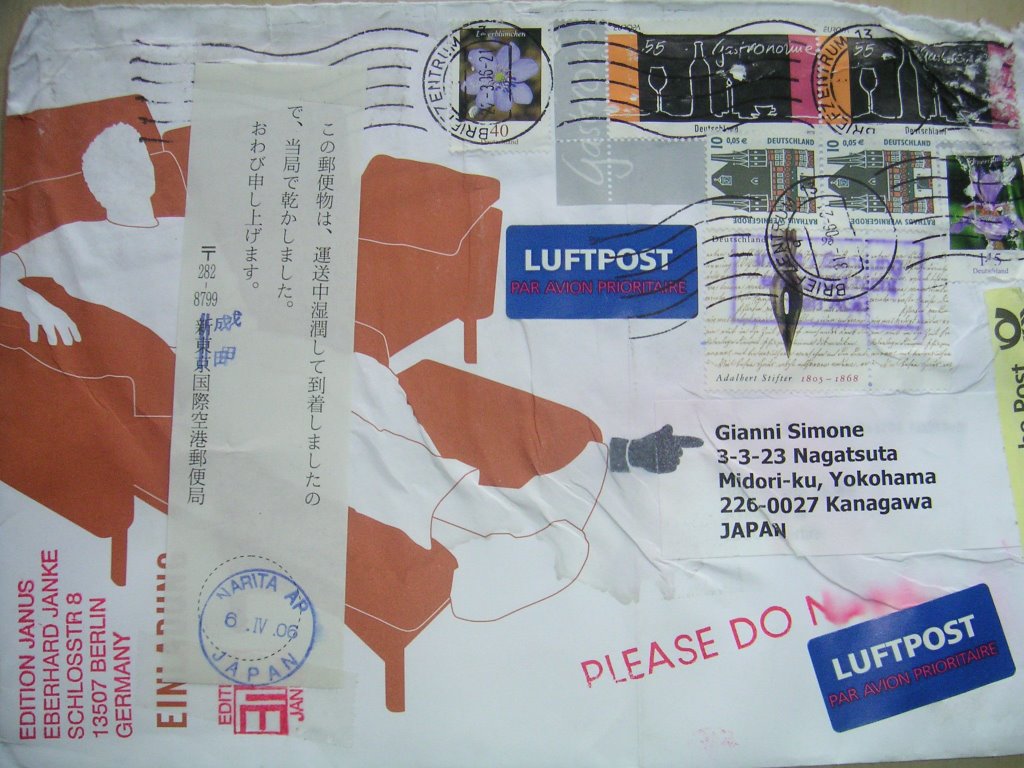 Yes, Sundays can be really gloomy. Or at least they used to be. Lately I manage to somewhat control myself - especially if the day before has been a good catch... Well, actually I should not complain about the postal service here: Japan is, in many respects, a paradise for all the lovers of the good ole (some say obsolete) art of letter writing. They always deliver the goods no matter what. Even if the sender has not put enough postage, the guys in green leave your mail in your box, of course adding a note in which they politely ask you to please go to the nearest post office and pay the difference (in Italy, il postino mafioso usually threatens to eat your letter in front of you if you don't pay on the spot). Rain, typhoons or earthquakes will never stop mail here. On the right you can see an envelope I got from German mail wunder-artist Eberhard Janke (of Edition Janus fame). For some reason it got completely wet before it could reach my house. On the left side you can see a brief not of apologies from the P.O. If you don't forgive them, they proceed to commit hara-kiri, like John Belushi's samurai in Saturday Night Live. Actually the accident caused the rubberstamp prints enclosed to bleed into each other, thus creating very interesting visual effects. Here's a nice example of chance collaboration between the artist and the postal service.
.0.jpg) On the other side of satisfaction - and of the Pacific - we find the truly evil postal clerks of Baltimore, USA. Look what they did to the poor envelope on the left. It all started because I wrote the name of a zine - Leeking Ink - instead of the one of its editrix - Davida Gypsy Breier. That was enough for them to return it to me. So I decided to try again, but I don't like to do things the easy way, so I re-used the returned envelope, this time writing the right name AND the nice note you can see on the left side: "Dear Mr/Ms Postman, THIS is the right address. Thank you in advance for your cooperation." The ever kind people at the Japanese post office were worried that all those stamps and symbols would create some confusion, so they crossed the "return to sender" stamp, and wrote "to USA" with a black marker. But to no avail: after a few weeks, the doomed envelope reappeared inside my mail box. I've decided to add it to my collection of weird mail...
On the other side of satisfaction - and of the Pacific - we find the truly evil postal clerks of Baltimore, USA. Look what they did to the poor envelope on the left. It all started because I wrote the name of a zine - Leeking Ink - instead of the one of its editrix - Davida Gypsy Breier. That was enough for them to return it to me. So I decided to try again, but I don't like to do things the easy way, so I re-used the returned envelope, this time writing the right name AND the nice note you can see on the left side: "Dear Mr/Ms Postman, THIS is the right address. Thank you in advance for your cooperation." The ever kind people at the Japanese post office were worried that all those stamps and symbols would create some confusion, so they crossed the "return to sender" stamp, and wrote "to USA" with a black marker. But to no avail: after a few weeks, the doomed envelope reappeared inside my mail box. I've decided to add it to my collection of weird mail...When you are finished reading this, you'll better check Davida's Web site: http://www.leekinginc.com/
Subscribe to:
Posts (Atom)

 Posts
Posts


