Thanks to Vittore Baroni's help - who guest edited the project - K17 is out.
Here's a review by Maria Zarro of Astrobabble fame (great zine for astro nerds and beyond)
http://astrobabylon.blogspot.com.au/2012/09/bizarrism-12-kairan-17.html
Showing posts with label Gianni's stuff for sale. Show all posts
Showing posts with label Gianni's stuff for sale. Show all posts
Monday, September 24, 2012


Sunday, March 15, 2009
Xerox
The book you see below was published last year by German copy-artist Klaus Urbons to document his exhibition/project on xerography.

2008 was the 70th anniversary of the invention of the photocopier, a machine which has played a pivotal role in dramatically expanding what (mail) artists and zine makers can do, and both Klaus and I decided to make a tribute to its inventor, Chester F. Carlson.
My contribution was yet another two-issue set of KAIRAN (#14 +15) that features works by some 90 copy-artists and several articles on the subjects.
A few copies are still available. If interested, please send US$6.00 for the set (or US$4.00 for one issue) to my address.
KAIRAN 10 + 11
The visual poem you see below was made by Japanese artist Hiroshi Tanabu who is among the contributors to KAIRAN 10 +11.

This two-issue set is entirely devoted to poetry in the mail art network. It's almost 90 pages full of poetry (word-based, visual, concrete, etc.) and poetry-related articles and interviews.
KAIRAN 10 features:
- a massive ABC by Guido Vermeulen, who introduces many artists who are seldom included in mail art publications.
- a photo-report by Bruno Chiarlone on his postal actions
- an article by Theo Breuer on visual poetry
- a report by Nancy Burr about the NorthWest Concrete/Visual Poetry Exhibition in Seattle
- a piece by Carla Bertola on sound poetry by Italian female artists
- plus poems by Giovanni Malito, Turk LeClair, Monica Ferretti, Marilyn Dammann, Francesco Mandrino, Bernd Reichert, etc.
KAIRAN 11 features:
- interviews with Harry Burrus, Mark Sonnenfeld, David Stone and Francesco Mandrino
- an article by Misako Yarita on concrete and visual poetry in Japan
- a piece by Keiichi Nakamura on collaboration in poetry and art
- opinions by Geof Huth, Michael Peters, and Michael Basinski on visual poetry
- plus tons of poems by Reed Altemus, Ficus Strangulensis, Jim Leftwitch, Jesse Glass, Jr, Willi Melnikhov, Laura Ryder, Pete Spence, etc.
A few copies are still available. If interested, please send US$ 6.00 or 5 euro for the nice pair (US$ 4.00 or 3 euro for a single issue) (well-concealed cash) or a good trade (you know what I mean) to:
Gianni Simone
3-3-23 Nagatsuta
Midori-ku
Yokohama-shi
226-0027 Kanagawa-ken
Japan
And remember that all the back issues are still available: in particular,
- #3 is partly devoted to the historical TRAX networking project
- #4 is devoted to mail art in former Yugoslavia
- #5 is a homage to Robin Crozier ("the most famous unknown artist in the world")
- #6 focuses on art & money
- #7 is devoted to mail art in Latin America
- #8 is about femail artists
- #9 contains a huge annotated index of mail art publications
Many of these issues also feature rubberstamp art, stickers, and artistamps.
Order today some of these great zines, so you don't have to go all the way to the MOMA in New York, the National Museum of Contemporary Art in Oslo or the Staatliches Museum in Schwerin, Germany to read them.
2,000 Staples
A few months ago I finally used the last few staples left in the box pictured below.

A few months ago I finally used the last few staples left in the box pictured below.

This makes 2,000 staples in nine years. It might not be a record, but in these last nine years my faithful long-arm stapler has helped me publishing 13 issues of KAIRAN - Mail Art Forum, three issues each of Call & Response and Orga{ni}sm plus several one-shot zines, mail art catalogues, etc.
I think I'm allowed to a little celebration, right?
Thursday, July 03, 2008
My Zines Reviewed
Well yes, sometimes you review, sometimes you get reviewed. This is what other publications think about my zines. In case you are interested, all of them are still available - for less than you folks pay your government to destroy the environment, kill other people and organise silly useless summits.
Call & Response #1 reviewed by Erin (One Fine Mess)
One thing is for sure: Call & Response is 2004's best English-language zine written by an Italian living in Japan. That's faint praise, so I should add that this engaging debut would stand out whatever the niche. In this issue, Gianni tells of travels, his occupation (teaching Italian to Tokyo-area students), his flair of filching photocopies, and his history in the world of mail art. Don't let the complicated overseas mailing address scare you, my pretties. Call & Response is worth that trip to the post office. [5.5” x 8.5”, $3 or 3 IRCs postpaid worldwide, selective trades (contact first)] jb64jp@yahoo.co.jp
Call & Response #1 reviewed by Doreen King (New Hope International Review http://www.geraldengland.co.uk/revs/)
This booklet has a mail art feel, with the personal, chatty and rather intimatefeel that mail art brings. It is full of short articles and anecdotes of the type that would not be out of place on a low ebb chat show. The artwork is very good
Call & Response #1 reviewed by Sean Stewart (The Zine Rack)
This is a new personal zine from passionate mail artist Gianni Simone. Most of the stories have been previously published in other places, but they still convey a unified, and intriguing, portrait of Gianni. And, as would be expected from a mail artist, the layout and graphics in here are top-notch. The color of the cover stock is really cool, too, and one that I’ve never seen before. And the cover features a color-copied photo of the man himself in India, posing with a four-legged companion. Topics inside range from a diary of photocopy thievery to breakfast in India, and from mail art to insect encounters. Gianni’s writing is expressive and articulate, even in his non-native language of English, which makes his new zine a pleasure to read. I’ll be looking forward to future issues!
Call & Response #3 / Orga{ni}sm #3 reviewed by Blackguard (http://blackguard23.livejournal.com)
How wonderful it was to recently learn about Gianni Simone's zines Orga{ni}sm and Call & Response (thanks to Xerography Debt!). In 1992 Gianni moved from Italy to Japan and has been living there ever since. He is a language teacher, teaching Italian to the Japanese. In 2004 he started up a zine, or two zines (not sure which came first since both are at #3) as a means to share his experiences and opinions of life in Japan. Gianni generously sent me Orga{ni}sm #1 and 2 plus the split Orga{ni}sm #3/Call & Response #3. His covers are very nice, with obvious handmade touches. When I was reading one on the bus I had people giving me curious and envious looks. All they had was a crummy iPod. Inside I read about Gianni's history and explanation of how he came to move to Japan, as well as his involvement with *mail art*. He rides an old streetcar line and documents the journey. Elsewhere he writes about food, like that available at Techno Sushi, a sushi restaurant where they blast deafening techno music to make you eat fast and leave quickly, and Strictly Ramen, a ramen joint ruled by the iron fist of Tokyo's answer to Seinfeld's Soup Nazi. On the grimmer side, his split zine focusses on prison and state-organised punishment of all kinds. Most fascinating in this issue was the details about life in a Japanese prison and the accompanying illustrations by Kazuichi Hanawa, a manga artist who spent time in prison and drew a manga about it. The zine also contains contributions from actual prisoners.
All three zines are fantastic and highly recommended. [Email Gianni at jb64jp@yahoo.co.jp to order copies, he is up for selective trades.]
Call and Response #4 reviewed by Astrogirlzarro, http://astrobabylon.blogspot.com/
A parcel arrived from Japan a few days ago, sent by the zine maestro, Gianni Simone, containing some of his exceptional zines, one of them being Call and Response. The zines were accompanied by a gracious letter written in Gianni’s distinctive handwriting (which resembles Japanese ideographic characters to my eyes) on the back of a photocopied image. Veteran zinesters never fail to amaze me with their proficient use of stationery, printed media, and innovative ideas when it comes to beautifying snail mail. The most ingenious I get is sticking cheap Betty Boop stickers randomly onto drab manila envelopes for my zine mail out. I’m not exactly letting my freak flag fly in the mail art department, but I’m working on it.
Issue four of Call and Response is a (mostly) black and white photocopied collaborative zine. The theme is Windows (as in the peep holes in buildings not the computer operating system). The stories vary in quality and are written by a clutch of zinesters in various stages of their self publishing journey. They attack the theme from different and fascinating angles; no two stories are alike.
Swedish contributor Mikael X Eriksson records some fine insights in his Libraries and Churches Saved My Life piece. He says:
‘there are two places where you can always sit in peace without having to spend any money: libraries and churches.'
It got me thinking about the astrological significance of what he said.
In the birth chart, libraries and churches are institutions traditionally ruled by the twelfth house of what is hidden from the mundane world. The institutions represented by this sector of the chart are not established for profiteering; they are organisations set up to shelter and protect the vulnerable (hostels and halfway houses); heal the sick (hospitals); reform the misfit (prison); educate the curious (universities and libraries); and provide solace to the seeker (churches). Eriksson states that he had a drinking problem and then lived rough. Libraries and churches played a significant part in his survival during this phase. The twelfth house demands that you confront your demons and take responsibility for your recovery within the parameters of these institutions. I think that Eriksson’s piece represents the twelfth house anecdote completely.
He ends his story experiencing true twelfth house divine home sickness:
'I’ve had many addresses in many cities. Never a place to call my home. I’ve come to understand that when I miss home, I miss a place inside myself. A place I’ve never lived in. A place I constantly long for and will probably never find.’
Eriksson, my man, I hope you find want what you’re looking for.
Call and Response also contains other gems written by Gianni himself, Andrew Culture, K Frank Jensen, and a couple of Australian journalists/zinesters, Dann Lennard and Helen Vnuk, who write about the view of Harris Park, a suburb in western Sydney, from their window. The stories are multi-layered, mature, and thoroughly engaging.
To discover more about zine extraordinaire Gianni Simone and his various self publishing projects, check out his blogs Gloomy Sundays at http://gloomy-sundays.blogspot.com/ and A Man Called Horse at http://man-horse.blogspot.com/. They are also good insights into Japan’s zine culture.
Well yes, sometimes you review, sometimes you get reviewed. This is what other publications think about my zines. In case you are interested, all of them are still available - for less than you folks pay your government to destroy the environment, kill other people and organise silly useless summits.
Call & Response #1 reviewed by Erin (One Fine Mess)
One thing is for sure: Call & Response is 2004's best English-language zine written by an Italian living in Japan. That's faint praise, so I should add that this engaging debut would stand out whatever the niche. In this issue, Gianni tells of travels, his occupation (teaching Italian to Tokyo-area students), his flair of filching photocopies, and his history in the world of mail art. Don't let the complicated overseas mailing address scare you, my pretties. Call & Response is worth that trip to the post office. [5.5” x 8.5”, $3 or 3 IRCs postpaid worldwide, selective trades (contact first)] jb64jp@yahoo.co.jp
Call & Response #1 reviewed by Doreen King (New Hope International Review http://www.geraldengland.co.uk/revs/)
This booklet has a mail art feel, with the personal, chatty and rather intimatefeel that mail art brings. It is full of short articles and anecdotes of the type that would not be out of place on a low ebb chat show. The artwork is very good
Call & Response #1 reviewed by Sean Stewart (The Zine Rack)
This is a new personal zine from passionate mail artist Gianni Simone. Most of the stories have been previously published in other places, but they still convey a unified, and intriguing, portrait of Gianni. And, as would be expected from a mail artist, the layout and graphics in here are top-notch. The color of the cover stock is really cool, too, and one that I’ve never seen before. And the cover features a color-copied photo of the man himself in India, posing with a four-legged companion. Topics inside range from a diary of photocopy thievery to breakfast in India, and from mail art to insect encounters. Gianni’s writing is expressive and articulate, even in his non-native language of English, which makes his new zine a pleasure to read. I’ll be looking forward to future issues!

Call & Response#2 reviewed by Keith Rosson (Razorcake http://www.razorcake.org/)
This one’s put together by the same guy that does Org{an}ism, and it could almost be considered an accompanying issue of that zine. This one also explores the theme of home and belonging, albeit with a lot more contributors this time around. Simone deserves a high-five for assembling a truly diverse group of contributors here. Standouts are 1.) John Adams’s scary account of being processed into prison—the delousing, the shower, the head-shaving, all the stuff in his pockets placed in an envelope and filed away for his release. 2.) Onjana Yawnghwe’s charming typewritten/hand-drawn history of all the houses she’s lived in throughout her life. 3.) Vincent Voelz’s lengthy story about moving from Minnesota to SF. See, that’s the cool thing about this zine: some of these stories are almost heartbreaking in their depth and sincerity, and some of them just detail trying to find home, trying to belong and feel a part of, in such a kind of average way that it’s so easy to relate to. That’s what makes this thing such a good read—that ability to identify. [$4, 5½” x 8½”, photocopied, 60 pgs]
Call & Response #2 reviewed by Quismada (Xerography Debt http://www.leekinginc.com/xeroxdebt/index.htm http://xerographydebt.blogspot.com/)
This is a collection of some highly talented writers who share their experiences about home. Give credit to zine maestro Gianni Simone for putting together yet another classy publication. Some of these writings will make you cry, others will make you snicker, either way, few people will read the zine without being touched in some way. The writers come from all over the globe and this zine is an open window to their lives. Put that travel book aside and if you're thinking about moving? Consult this zine first.
Call & Response #2 reviewed by Geoff Huth (http://dbqp.blogspot.com/)
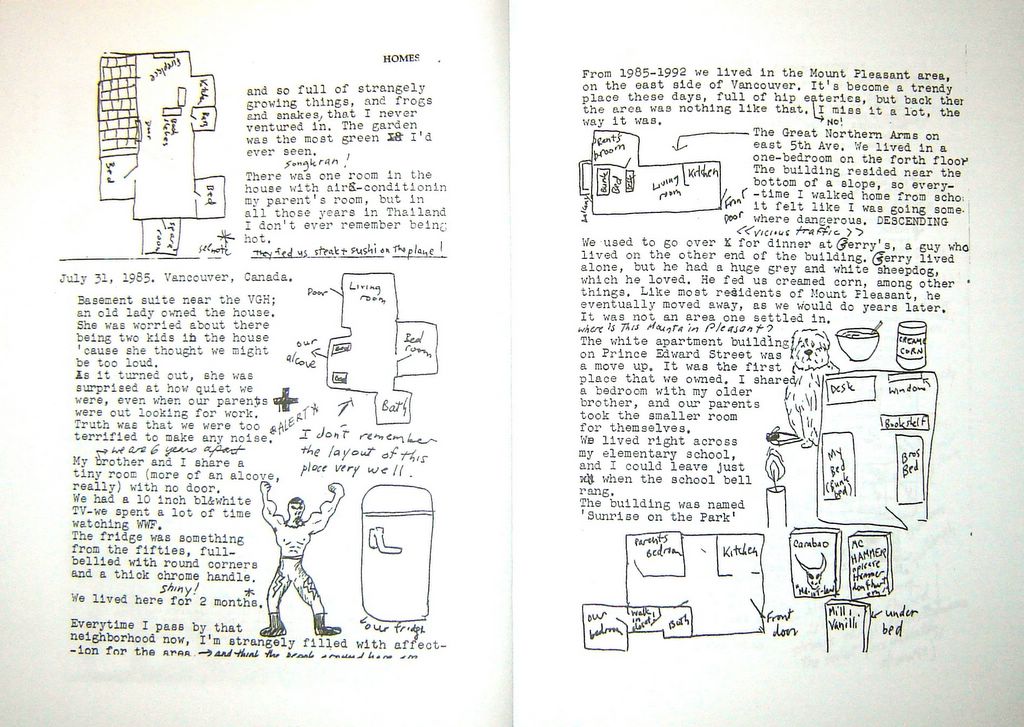
Yesterday, I received a copy of the second issue of Call & Response, another zine from Gianni Simone, an Italian who seems to create only English-language zines while living in Japan. As with anything I receive from Gianni, this zine is carefully crafted. In this case, part of that craft is explained by the subtitle of the issue: "at home -- not at home." Gianni asked a number of his correspondents to write about "traveling - living abroad - culture shock - cultural heritage - feeling an outsider in the place where you live - different concepts of 'home.' This zine of Gianni's gives us some insight into others' points of view about home and how those changed over their lives. The visual poet David Baptiste Chirot writes about the concept "Home is where I hang my hat," recounts a non-meeting in Paris with the hat of William Saroyan, and tells us about living overseas and in a transitional home in Milwaukee. A couple of his famous frottage poems (which he calls "rubBEings") bookend his essay. The mailartist Bernd Reichert, whose work is often vispoetic, includes a small multilingual collage as well as the story of an East German self-exiling himself to Belgium after the reunification of Germany. Randall Osborne tells a too-short story of a home broken up and of how both of his names slowly changed on him against his will. Carlos M. Luis, "the great gesture writer of visual poetry," writes about being a Cuban immigrant to America, whose views are anti-Castro yet not in line with the Cuban-American majority.Onjana Yawnghwe tells us about her life in Thailand and the corollary of that life in Vancouver. She tells us a fully verbo-visual story. She draws simple pictures of her homes (often they layouts), types her story around those pictures, and then emends the text by hand. This ends up giving her story a childlike quality that I enjoyed.
But I'm giving away too many of the stories. There are six or seven more. This zine is the first in a long time that brings back to me a whiff of the Factsheet Five era, when my friend Mike Gunderloy served as the central node of a huge network of zines, when my mailbox was always full of some sweet gift from Asia or Europe or North America. (Gianni, for instance, writes the bios of each of his correspondents in this issue, giving the boring author bio some life and relevance.) This zine reminds of the network that once was. But it is mostly about the stories.We hear four stories from visual poets alone in these pages, two stories from people whose fathers were diplomats, two stories that mention tamarinds, as well as stories from Asia, Europe, Africa, the Middle East, and both Americas. All of the people we hear from are artists of some kind, but of the type I call invisible artists (because I am one myself). Invisible artists don't make a big splash, don't really become famous, don't make any noticeable money off their art, and sometimes live the usual lives of usual people in unusual ways. There are some great stories in here, simply told, along with a few surprises about the lives of visual poets.
Call & Response is available for $4 or 3 IRCs worldwide. email.
Orga{ni}sm #1 reviewed by Davida Gypsy Breier (Xerography Debt #16)
I've been interested in Japan since becoming friends with a Japanese freelance writer a few years ago. I think about going to visit her in Tokyo one day. It is captivating to read about a place you want to visit, especially through the eyes of someone who lives there, yet who started as an outsider.In addition to Gianni's description of the city, food, and movies, and mass transit, Brant Kresovich (For the Clerisy zine) offers an essay about Jack Seward, Robin Bougie (Cinema Sewer zine) dreams about Japan, and Gigantor has a strange job interview. Recommended.
Orga{ni}sm #2 reviewed by Stephanie Holmes (Xerography Debt #20)
This is a travel and personal zine about the author's life in Japan. It's awonderful blend of essays (one to note is one about the first Western immigrants in Japan) and personal accounts including modern tales of healthcare in Japan, people watching on a train, memories of cultural integration by revisiting the author's stash of personal letters, and interactive lists (report of communication between author and readers) about free things to do and have in the city. Also includes contributions from two of XD's own, Bobby Tran Dale and Brent Kresovich (For the Clerisy zine). Highly recommended
Orga{ni}sm #2 reviewed by Keith Rosson (Razorcake)
Written in English by an Italian currently residing in Japan. The theme of this issue is “first contacts,” and Simone and Orga{ni}sm’s few contributors do a great job sticking with the theme while still keeping things interesting. While the majority of it is centered around Japan (things you can do/get for free, people-watching on the train, a history of immigration to the country, etc.), there’s also a running, almost unspoken undercurrent of just trying to feel at home in a place that is very, very different from what you’re used to. That’s what makes this thing such a captivating read. While there’s nothing explicitly “punk” about this, the writing and content transcends that—it’s a pretty consuming zine, put together by the same guy that does Call And Response. [$4, 5½” x 8½”, copied, 48 pgs.]
Orga{ni}sm #2 reviewed by Caroline (Zine World #25 http://www.undergroundpress.org/ )Color cover with great layout and formatting, well-organized and easily guides the reader into its pages. Many articles about life in Japan from a sociological perspective, written well and often from a wry perspective. Included in this issue is a packet of tissues with the following curse, “Issue #2 comes with a free packet of tissues. The packet cannot be sold separately. Those who will try to sell the tissues for personal gain are going to catch a deadly case of bird flu.” Very good read, well worth the time. jb64jp@yahoo.co.jp [$4 US or 3 IRC’s 44S :30]

Call & Response #3 / Orga{ni}sm #3 reviewed by Lauren Trout (Razorcake)
This split is pretty rad. Orga{ni}sm features personal horror stories and straight facts dealing with the Japanese legal and prison systems, which take the cultural standards of conformity and subordination to extremes. Call & Response publishes firsthand accounts of prison conditions and some broader information related to the problems that plague the prison system in America. This split is remarkable to me because it manages to avoid articles full of anti-prison rhetoric and news about the handful of American political prisoners who have received national attention—topics that have been covered to death in prison-themed literature. This is a great personal zine of well-written contributions from different people who happen to be incarcerated or are interested in sharing information about the prison system. (jb64jp@yahoo.co.jp) [$4 ppd., 5'' x 8'', photocopied w / color cover, 56 pgs.]
Call & Response and Orga{ni}sm reviewed by http://www.syndicateproduct.com/
As mentioned earlier this year, I’ve had a rough time finding zines that aren’t just perzines disguised as reprints of LiveJournal entries. These two zines from an Italian ex-pat living in Japan were a pleasant wake-up call – the writing from Gianni and contributors is just plain interesting to read. He’s also Xerography Debt’s resident mail art expert, and maintains a blog about mail art and zines, Gloomy Sundays. Send $6 for both to Gianni Simone. You’ll receive an artfully decorated envelope with cool stamps!
Call & Response #3 / Orga{ni}sm #3 reviewed by Dann Lennard (Betty Paginated) [This interview was originally slated for publication in Zine World #26 but was sent too late and didn't make it - my fault, not Dann's]
I enjoyed the articles in this split zine that examines prison life in Japan and abroad, even if I’m not sympathetic to many of the sentiments. Yeah, prison life is terrible – I get it. It’s just…well, they’re CRIMINALS and deserve to be in locked up. I can’t feel sorry for the fuckers. Still, I thought the zine was interesting. Life in prison is shit – and it’s fascinating to learn how inmates cope with their daily lives. But, frankly, they got themselves into this mess, so…y’know… jb64jp@yahoo.co.jp [US$4 post-paid worldwide 56S :45]
Call & Response #3 / Orgna{ni}sm #3 reviewed by Emerson Dameron (Zine Thug #12) (to read the whole review: http://www.zinethug.com/)
America has a larger percentage of incarcerated citizens than any other nation on earth. (...) Prison might be the only growth industry we've got left. Yes, there are sociopathic assholes in our midst, and I'd rather not split a cab with them, but America's prison-industrial complex is an out-of-control monster, no one seems to know what most of these people are actually in for, and no one seems to be talking about it in mass earshot. Both sides of this split are devoted to prisoners, pretty much the only American zine writers who have any beeswax calling their shit 'zsamizdat. ' C&R showcases the paint-peeling wit of inmate John Adams and the addictive freestyling of inmate Seth Ferranti. (...) The deceptively precious title Orga {ni }sm reps joint life in should-be-zine-god Gianni Simone's adopted Japanese homeland, complete with goofy illustrations. This issue's pick o' the litter, easy. jb64jp@yahoo.co.jp
Call & Response #3 / Orga{ni}sm #3 reviewed by Blackguard (http://blackguard23.livejournal.com)
How wonderful it was to recently learn about Gianni Simone's zines Orga{ni}sm and Call & Response (thanks to Xerography Debt!). In 1992 Gianni moved from Italy to Japan and has been living there ever since. He is a language teacher, teaching Italian to the Japanese. In 2004 he started up a zine, or two zines (not sure which came first since both are at #3) as a means to share his experiences and opinions of life in Japan. Gianni generously sent me Orga{ni}sm #1 and 2 plus the split Orga{ni}sm #3/Call & Response #3. His covers are very nice, with obvious handmade touches. When I was reading one on the bus I had people giving me curious and envious looks. All they had was a crummy iPod. Inside I read about Gianni's history and explanation of how he came to move to Japan, as well as his involvement with *mail art*. He rides an old streetcar line and documents the journey. Elsewhere he writes about food, like that available at Techno Sushi, a sushi restaurant where they blast deafening techno music to make you eat fast and leave quickly, and Strictly Ramen, a ramen joint ruled by the iron fist of Tokyo's answer to Seinfeld's Soup Nazi. On the grimmer side, his split zine focusses on prison and state-organised punishment of all kinds. Most fascinating in this issue was the details about life in a Japanese prison and the accompanying illustrations by Kazuichi Hanawa, a manga artist who spent time in prison and drew a manga about it. The zine also contains contributions from actual prisoners.
All three zines are fantastic and highly recommended. [Email Gianni at jb64jp@yahoo.co.jp to order copies, he is up for selective trades.]
Call and Response #4 reviewed by Astrogirlzarro, http://astrobabylon.blogspot.com/
A parcel arrived from Japan a few days ago, sent by the zine maestro, Gianni Simone, containing some of his exceptional zines, one of them being Call and Response. The zines were accompanied by a gracious letter written in Gianni’s distinctive handwriting (which resembles Japanese ideographic characters to my eyes) on the back of a photocopied image. Veteran zinesters never fail to amaze me with their proficient use of stationery, printed media, and innovative ideas when it comes to beautifying snail mail. The most ingenious I get is sticking cheap Betty Boop stickers randomly onto drab manila envelopes for my zine mail out. I’m not exactly letting my freak flag fly in the mail art department, but I’m working on it.
Issue four of Call and Response is a (mostly) black and white photocopied collaborative zine. The theme is Windows (as in the peep holes in buildings not the computer operating system). The stories vary in quality and are written by a clutch of zinesters in various stages of their self publishing journey. They attack the theme from different and fascinating angles; no two stories are alike.
Swedish contributor Mikael X Eriksson records some fine insights in his Libraries and Churches Saved My Life piece. He says:
‘there are two places where you can always sit in peace without having to spend any money: libraries and churches.'
It got me thinking about the astrological significance of what he said.
In the birth chart, libraries and churches are institutions traditionally ruled by the twelfth house of what is hidden from the mundane world. The institutions represented by this sector of the chart are not established for profiteering; they are organisations set up to shelter and protect the vulnerable (hostels and halfway houses); heal the sick (hospitals); reform the misfit (prison); educate the curious (universities and libraries); and provide solace to the seeker (churches). Eriksson states that he had a drinking problem and then lived rough. Libraries and churches played a significant part in his survival during this phase. The twelfth house demands that you confront your demons and take responsibility for your recovery within the parameters of these institutions. I think that Eriksson’s piece represents the twelfth house anecdote completely.
He ends his story experiencing true twelfth house divine home sickness:
'I’ve had many addresses in many cities. Never a place to call my home. I’ve come to understand that when I miss home, I miss a place inside myself. A place I’ve never lived in. A place I constantly long for and will probably never find.’
Eriksson, my man, I hope you find want what you’re looking for.
Call and Response also contains other gems written by Gianni himself, Andrew Culture, K Frank Jensen, and a couple of Australian journalists/zinesters, Dann Lennard and Helen Vnuk, who write about the view of Harris Park, a suburb in western Sydney, from their window. The stories are multi-layered, mature, and thoroughly engaging.
To discover more about zine extraordinaire Gianni Simone and his various self publishing projects, check out his blogs Gloomy Sundays at http://gloomy-sundays.blogspot.com/ and A Man Called Horse at http://man-horse.blogspot.com/. They are also good insights into Japan’s zine culture.
Sunday, July 15, 2007
,Mail Art and Politics
One thing tha many mail artist always like to stress when talking about their activities (although many others don't seem to agree) is that the communicative aspect is far more important than art for art’s sake, and collaboration is one of the key words in the Network, whose ultimate goal is building a sort of alternative approach to culture. This is a practice that the advent of the Internet has amplified to enormous proportions. All these different but often overlapping networks share many strategies and the common principle that “if the Establishment ignores us, we can easily do without it.”
One notable consequence of this approach is that many mail artists are socially and/or politically committed and strive to include these issues in their activity. Here are two examples of the innumerable projects that are constantly being organised. Both of them where started by me (you will excuse me for showing off a little bit …).
Fighting Back - Stop Violence against Women was born because I’m a member of Amnesty International, the worldwide voluntary activist movement working for human rights. At the end of every year, AI Japan reports on its state of health, and the recurring theme in recent years has been that we are constantly losing members and in this country, AI has become more or less an invisible entity. So we felt the need to enhance our public image, trying, in the process, to lure more people into our ranks.

When another member pointed out that the 2004-2006 worldwide campaign would have focused on domestic violence against women, as well as violence in conflict and post conflict, we decided to ask mail artists for help. This, by the way, is by no means the first time that AI and the Network have joined hands to address specific problems (other topics tackled in the past have been torture and the death penalty). A task group was formed, with me concentrating on the mail art part of the project (writing the call, spreading the word, and instructing the others on how to collect and catalogue the incoming works) while other people looked for a suitable venue for the exhibition, invited experts and activists to talk, and organised other collateral activities.


All in all we were able to gather more than 250 contributions from all over the world, including postcards, collages, drawings, photographs, etc, and even local artists, who usually are not active in the mail art network, lent or donated paintings, sculptures and embroidery. The show was a huge success and it travelled to several cities.
Now that this part of the project is over, we are left with hundreds of copies of the catalogue. This is a beautiful, full-color, full-sized 24 page booklet, printed on glossy paper, containing a wide range of the works received, plus brief introductions to Amnesty International, mail art and the theme of the exhibition. If you are interested in visual arts and/or violence against women, or you simply want to help AI Japan to recover at least a part of the expenses, please contact me (jb64jp@yahoo.co.jp) One copy costs $5 to $7 on a sliding scale, postpaid worldwide. Please pay what you can afford and remember that it’s for a just cause.
Mail artists usually interact either by participating in big international exhibitions or on a one-to-one basis. The AI project was an example of the first type. The next project I’d like to describe belongs to the second and is a perfect example of what I like most in mail art: the many possibilities to collaborate and interact with a wide network of like-minded people.
It all started in 1998, when – as a contribution to Vittore Baroni’s Year of Incongruous Meetings – I made a couple of fake election campaign posters (it was election time in Japan) and briefly put them on the same billboard near my house where all the local candidates had put their ugly faces. The idea behind this action was that political elections have become a farce and are almost useless to really change society. It’s a rat race in which every candidate only aims at joining the elite and share power and money. The election posters they make in Japan are particularly cheesy and phoney and you can often see the horrible truth behind the candidates’ smiling masks. After that isolated performance, I decided to start a project, that I called The True Face of Politics, in which I invited some of my friends to make and send me their posters. I collected several works, but once it came to put them on the billboards, I realised I couldn’t do everything by myself, and the people who had offered to help, suddenly became unavailable. I can’t really blame them: after all, what I wanted to do was illegal, and to challenge authority while you live in a foreign country isn’t really a sane thing to do.
This way, the project became a sleeper, and has been kept on hold until now. A couple of years ago I finally found the time and energy to start working on it again, and was lucky to find a group of networkers who were all too happy to collaborate. So I made copies of the posters and sent them to Australia, China, Uruguay, and the US, where each one of my friends did what he or she wanted (or could do: the Shanghai part of the project was for obvious reasons a more private/secret thing).
When everything was over, my collaborators sent me the documentation they had produced (reports, photos, etc.) and now I’m finally putting everything together and producing the final doc, that will be included in my zine KAIRAN. Let me know if you want to order a copy of the forthcoming issue #13.
One thing tha many mail artist always like to stress when talking about their activities (although many others don't seem to agree) is that the communicative aspect is far more important than art for art’s sake, and collaboration is one of the key words in the Network, whose ultimate goal is building a sort of alternative approach to culture. This is a practice that the advent of the Internet has amplified to enormous proportions. All these different but often overlapping networks share many strategies and the common principle that “if the Establishment ignores us, we can easily do without it.”
One notable consequence of this approach is that many mail artists are socially and/or politically committed and strive to include these issues in their activity. Here are two examples of the innumerable projects that are constantly being organised. Both of them where started by me (you will excuse me for showing off a little bit …).
Fighting Back - Stop Violence against Women was born because I’m a member of Amnesty International, the worldwide voluntary activist movement working for human rights. At the end of every year, AI Japan reports on its state of health, and the recurring theme in recent years has been that we are constantly losing members and in this country, AI has become more or less an invisible entity. So we felt the need to enhance our public image, trying, in the process, to lure more people into our ranks.
When another member pointed out that the 2004-2006 worldwide campaign would have focused on domestic violence against women, as well as violence in conflict and post conflict, we decided to ask mail artists for help. This, by the way, is by no means the first time that AI and the Network have joined hands to address specific problems (other topics tackled in the past have been torture and the death penalty). A task group was formed, with me concentrating on the mail art part of the project (writing the call, spreading the word, and instructing the others on how to collect and catalogue the incoming works) while other people looked for a suitable venue for the exhibition, invited experts and activists to talk, and organised other collateral activities.


All in all we were able to gather more than 250 contributions from all over the world, including postcards, collages, drawings, photographs, etc, and even local artists, who usually are not active in the mail art network, lent or donated paintings, sculptures and embroidery. The show was a huge success and it travelled to several cities.
Now that this part of the project is over, we are left with hundreds of copies of the catalogue. This is a beautiful, full-color, full-sized 24 page booklet, printed on glossy paper, containing a wide range of the works received, plus brief introductions to Amnesty International, mail art and the theme of the exhibition. If you are interested in visual arts and/or violence against women, or you simply want to help AI Japan to recover at least a part of the expenses, please contact me (jb64jp@yahoo.co.jp) One copy costs $5 to $7 on a sliding scale, postpaid worldwide. Please pay what you can afford and remember that it’s for a just cause.
Mail artists usually interact either by participating in big international exhibitions or on a one-to-one basis. The AI project was an example of the first type. The next project I’d like to describe belongs to the second and is a perfect example of what I like most in mail art: the many possibilities to collaborate and interact with a wide network of like-minded people.
It all started in 1998, when – as a contribution to Vittore Baroni’s Year of Incongruous Meetings – I made a couple of fake election campaign posters (it was election time in Japan) and briefly put them on the same billboard near my house where all the local candidates had put their ugly faces. The idea behind this action was that political elections have become a farce and are almost useless to really change society. It’s a rat race in which every candidate only aims at joining the elite and share power and money. The election posters they make in Japan are particularly cheesy and phoney and you can often see the horrible truth behind the candidates’ smiling masks. After that isolated performance, I decided to start a project, that I called The True Face of Politics, in which I invited some of my friends to make and send me their posters. I collected several works, but once it came to put them on the billboards, I realised I couldn’t do everything by myself, and the people who had offered to help, suddenly became unavailable. I can’t really blame them: after all, what I wanted to do was illegal, and to challenge authority while you live in a foreign country isn’t really a sane thing to do.
This way, the project became a sleeper, and has been kept on hold until now. A couple of years ago I finally found the time and energy to start working on it again, and was lucky to find a group of networkers who were all too happy to collaborate. So I made copies of the posters and sent them to Australia, China, Uruguay, and the US, where each one of my friends did what he or she wanted (or could do: the Shanghai part of the project was for obvious reasons a more private/secret thing).
When everything was over, my collaborators sent me the documentation they had produced (reports, photos, etc.) and now I’m finally putting everything together and producing the final doc, that will be included in my zine KAIRAN. Let me know if you want to order a copy of the forthcoming issue #13.
Do you like horror stories? Lately I find it increasingly difficult to find good ones, especially when it comes to movies. It seems that coming up with engaging, original plots is getting harder and harder. Even so called J-Horror (the recent new wave of films from Japan that became popular worldwide thanks to The Ring has reached a cul-de-sac. Oddly enough, some of the people who have recently provided me with the best bad vibes are sound artists…
Take, for example, Mark Sonnenfeld. Many of you should at least know his name because his booklets are often reviewed in a number of zine review zines. Mark has been very active in the mail art and experimental poetry circuits for many years now, but I recently discovered a new side of his creativity, when I found in my mailbox Experimental Tape New Jersey #2 that he produced together with the mysterious Ghostly Bus. ETNJ#2 is a slow-burning piece of suspense. Mark & GB avoid any loud noise, instead insinuating themselves into your ears with muffled sounds, strange voices, ringing telephones, and a robotik funk riff. This tape was the ideal soundtrack while reading the truly dreadful Gerald’s Game by Stephen King, one of the few writers who can still make the hair on my neck stand.

The never-resting Sonnenfeld even collaborated with Ken Miller, another mail artist who likes to play (with) music. Miller added a catchy bass riff to a street recording of Mark’s A Red Shirted No Friends. The quiet main theme blends wonderfully with Mark’s plain recitation. Only in the mid-section things go a little crazy, when Ken juxtaposes two different vocal tracks and starts experimenting with music, but always in a very soft way.


Take, for example, Mark Sonnenfeld. Many of you should at least know his name because his booklets are often reviewed in a number of zine review zines. Mark has been very active in the mail art and experimental poetry circuits for many years now, but I recently discovered a new side of his creativity, when I found in my mailbox Experimental Tape New Jersey #2 that he produced together with the mysterious Ghostly Bus. ETNJ#2 is a slow-burning piece of suspense. Mark & GB avoid any loud noise, instead insinuating themselves into your ears with muffled sounds, strange voices, ringing telephones, and a robotik funk riff. This tape was the ideal soundtrack while reading the truly dreadful Gerald’s Game by Stephen King, one of the few writers who can still make the hair on my neck stand.

The never-resting Sonnenfeld even collaborated with Ken Miller, another mail artist who likes to play (with) music. Miller added a catchy bass riff to a street recording of Mark’s A Red Shirted No Friends. The quiet main theme blends wonderfully with Mark’s plain recitation. Only in the mid-section things go a little crazy, when Ken juxtaposes two different vocal tracks and starts experimenting with music, but always in a very soft way.

Miller’s usual stomping ground, though, is his almost one-man-band SinDex Industries – formerly (un)known as Sinister Dexter – through which he explores and sometimes abuses American musical tradition. Particularly good is the anthology Fifteen Years (1984-1999) in which you will find, among other things, weird blues songs; rock songs whose lyrics were pulled at random from a car repair manual; a couple of more atmospheric tracks; great versions of Beatles and Clash songs; and an effect of Ken’s invention called “Miracle Earache” which according to Mr. Miller, “along with producing the worst feedback imaginable, picks up several channels of AM radio. The album’s notes, by the way, are as hilarious and good as the music.
As every horror fan knows very well, the best stories often are the ones that deal with everyday life and ordinary people. In this sense one of the best recent projects I stumbled upon is the Quotidian Assemblages 3-CD series edited and produced by Hal McGee.
As every horror fan knows very well, the best stories often are the ones that deal with everyday life and ordinary people. In this sense one of the best recent projects I stumbled upon is the Quotidian Assemblages 3-CD series edited and produced by Hal McGee.

For those who don’t know him, Hal is a senior member of the huge D.I.Y. tape network that originated in the 70s and developed worldwide with more than a few contacts with the mail art community. Hal had the brilliant idea to invite a wild bunch of Mad Professors to create audio works based upon ordinary everyday sounds. Loren Steele, for example, shows you how a not-well-oiled window can upset your nerves. G..X. Jupitter-Larsen's plain field recording of the Paris metro acquires new sinister tones after the terrorist London bombings. Mystified’s “Pan Pan Pot Spoon” is all in its title, but the overall effect is as spooky as a Tibetan thriller. And then you have evil washing machines, undigested breakfasts, dog-walking gone wrong, apocalyptic radio news…
Perpetually house-moving mail artist and poet Jessy Kendall is another person who likes all-round playing. As Marcel Herms wrote in the third issue of his excellent zine Rigodon regarding Jessy’s CD Rough Ride of Crafts, “It’s always a good thing when you can’t immediately pigeonhole a record. Like this one.” Jessy uses a bunch of fairly conventional instruments on his release, but the end result is quite unconventional – not as creepy as I would like though… It jumps from voice-experiments to a synth-bass-based psychedelic jam to some weird loops. But its experimentation is always soft, and quite entertaining.


Perpetually house-moving mail artist and poet Jessy Kendall is another person who likes all-round playing. As Marcel Herms wrote in the third issue of his excellent zine Rigodon regarding Jessy’s CD Rough Ride of Crafts, “It’s always a good thing when you can’t immediately pigeonhole a record. Like this one.” Jessy uses a bunch of fairly conventional instruments on his release, but the end result is quite unconventional – not as creepy as I would like though… It jumps from voice-experiments to a synth-bass-based psychedelic jam to some weird loops. But its experimentation is always soft, and quite entertaining.


Among other things, Jessy publishes a couple of interesting zines: a monthly collection of his poems and Answer Shirker, which features other people’s works, some in color [above left you can see a collaborative work he made with Jim Leftwich). His letters are very interesting too.
When not working on Rigodon (US$ 7.00) (a publication mostly devoted to noise & experimental music), Herms himself loves to torture your ears and brain with his usually very loud productions. Check them out at your own risk.
When not working on Rigodon (US$ 7.00) (a publication mostly devoted to noise & experimental music), Herms himself loves to torture your ears and brain with his usually very loud productions. Check them out at your own risk.
As I mentioned earlier, you don’t have to escape into the realm of ghosts and monsters to get your daily dose of horror. In this respect, the best CD that recently found its way into my mailbox is without doubt Franetta McMillian’s Reveries of the Solitary Walker (US$ 10.00).

Among these very well produced songs (actually more poetry with music) you will find scathing condemnations of past and current American politics, and of contemporary society; a sad, moving tale of domestic violence; a clever send-off of fanaticism, fundamentalism and terrorism; and a piece that could be defined as pro-euthanasia (see below). Actually there is much, much more in this excellent album, including seven instrumentals, and not everything is as bleak as I make it sound. Indeed, the overall mood is one of hope.


Okay, back to the classics, let me mention quickly a tape I made some time ago. The Overlook is a reworking of The Shining (yes, King again). A friend of mine recorded excerpts from the novel, which I mixed with old music from my own collection – nothing original – mostly alternative rock (e.g. Cassiber and Art Bears) and other strange music (Pierre Henry, Negativeland). It’s quite rough around the aural edges, but all in all it’s satisfyingly dark. If you want to give it a try, send me US$ 4.00 or an equivalent trade.
Thank you and good night.

Mark Sonnenfeld, 45-08 Old Millstone Drive, East Windsor, NJ 08520, USA
Ken Miller, P.O. Box, 101, Newtown, PA 18940-0101, USA <kenbmiller@gmail.com> <www.kenbmiller.com/satpostman>
Hal McGee, 1909E SW 42 Way, Gainesville, FL 32607, USA <Haltapes1@aol.com> <http://www.halmcgee.com/>


Okay, back to the classics, let me mention quickly a tape I made some time ago. The Overlook is a reworking of The Shining (yes, King again). A friend of mine recorded excerpts from the novel, which I mixed with old music from my own collection – nothing original – mostly alternative rock (e.g. Cassiber and Art Bears) and other strange music (Pierre Henry, Negativeland). It’s quite rough around the aural edges, but all in all it’s satisfyingly dark. If you want to give it a try, send me US$ 4.00 or an equivalent trade.
Thank you and good night.

Mark Sonnenfeld, 45-08 Old Millstone Drive, East Windsor, NJ 08520, USA
Ken Miller, P.O. Box, 101, Newtown, PA 18940-0101, USA <kenbmiller@gmail.com> <www.kenbmiller.com/satpostman>
Hal McGee, 1909E SW 42 Way, Gainesville, FL 32607, USA <Haltapes1@aol.com> <http://www.halmcgee.com/>
Jessy Kendall, shirk@riseup.net
Marcel Herms, Postbus 6359, 7401 JJ Deventer, The Netherlands mherms@home.nl
Franetta McMillian, PMB 170, 40 E. Main St, Newark, DE 19711 marybld@aol.com
Gianni Simone, 3-3-23 Nagatsuta, Midori-ku, Yokohama-shi, 226-0027 Kanagawa-ken, Japan jb64jp@yahoo.co.jp
Marcel Herms, Postbus 6359, 7401 JJ Deventer, The Netherlands mherms@home.nl
Franetta McMillian, PMB 170, 40 E. Main St, Newark, DE 19711 marybld@aol.com
Gianni Simone, 3-3-23 Nagatsuta, Midori-ku, Yokohama-shi, 226-0027 Kanagawa-ken, Japan jb64jp@yahoo.co.jp
Subscribe to:
Posts (Atom)

 Posts
Posts