Thanks to Vittore Baroni's help - who guest edited the project - K17 is out.
Here's a review by Maria Zarro of Astrobabble fame (great zine for astro nerds and beyond)
http://astrobabylon.blogspot.com.au/2012/09/bizarrism-12-kairan-17.html
Showing posts with label mail art. Show all posts
Showing posts with label mail art. Show all posts
Monday, September 24, 2012


Tuesday, September 08, 2009
Hinchcliff/Johnson

I saw the interesting movie Black, White + Grey: A Portrait of Sam Wagstaff and Robert Mapplethorpe, a James Crump documentary about the famous American collector. Even though his relationship with Mapplethorpe takes center stage, the movie is mainly about Wagstaff, his life, and the people he met in the frantic NY art world - among them "an eccentric artist named Ray Johnson."

This same photo appears in the movie (Johnson is only briefly mentioned... let's say his part in the movie is about 2-3 seconds) and a zine I received from m.a. queen Jennie Hinchcliff.

I saw the interesting movie Black, White + Grey: A Portrait of Sam Wagstaff and Robert Mapplethorpe, a James Crump documentary about the famous American collector. Even though his relationship with Mapplethorpe takes center stage, the movie is mainly about Wagstaff, his life, and the people he met in the frantic NY art world - among them "an eccentric artist named Ray Johnson."

This same photo appears in the movie (Johnson is only briefly mentioned... let's say his part in the movie is about 2-3 seconds) and a zine I received from m.a. queen Jennie Hinchcliff.
Sunday, March 15, 2009
In Memory of a New Friend
In 1998 I met through the post German mail artist Johannes Musholf. We happened to have a friend in common (not a rare thing in our Network), Ivan Zemtsov from Russia. As our names were different versions of the English 'John' I came up with the idea of forming a collaborative group whose name was supposed to be The Three Johns (anybody remembers the British new wave band of the '80s?). Sadly Johannes suddenly died in 1999. As a tribute to him I've uploaded the last thing he sent me before passing away. Johannes was fond of telling stories, and that was one of the things I liked the most about him.


In 1998 I met through the post German mail artist Johannes Musholf. We happened to have a friend in common (not a rare thing in our Network), Ivan Zemtsov from Russia. As our names were different versions of the English 'John' I came up with the idea of forming a collaborative group whose name was supposed to be The Three Johns (anybody remembers the British new wave band of the '80s?). Sadly Johannes suddenly died in 1999. As a tribute to him I've uploaded the last thing he sent me before passing away. Johannes was fond of telling stories, and that was one of the things I liked the most about him.


Tourism (2)
I should have posted this one several months ago, but as the more faithful followers of this blog know all too well, I'm constantly fighting my chronic laziness.
This said, I still remember with great fondness the nice meeting I had with fellow mail artists Antic Ham (South Korea), Francis Van Maele (Luxemburg, now living in Ireland) and Keiichi Nakamura (Japan).

Japan post
I think I have mentioned before how wonderful the postal service in Japan is. They will deliver the goods no matter what, and will even apologise for something they haven't done in the first place. Here are a couple of examples, respectively coming from the US (slightly broken envelope) and Serbia (flood- or typhoon-altered envelope)


The second envelope contained Dobrica Kamperelic's long-running zine Open World. As you can see, the zine itself got a nice treatment that added some colour to its usually b/w design.

Now, THIS is a mail art catalogue
Once upon a time, paper ruled mail art. People wrote letters (imagine that), didn’t know what a computer was, and all the project documentation was in paper form, ranging from simple lists of participants to thick catalogues. Nowadays most people opt for posting all the works in a blog, mainly because it’s less labor intensive and definitely cheaper. Still, once in a whole I come across an old school doc, and the zine that Mujinga produced for his project Utopia is very well worth mentioning.
Inside you will find a brief description of the works he received, the usual list of contributors and, most importantly, a discussion on what mail art is and an interesting piece on how and why he embarked in this project, including the problems he encountered and the lessons he learned. All in all it’s a very useful primer for people who are thinking about doing the same thing, or are interested in the subject, and even includes a handy list of mail art-related web sites.
$2/Digest/20 pgs
Mujinga/Edward, 1 Delves Cottages, Church Hill, Ringmer, Lewes BN8 5JY, UK
spaceman@mujinga.net or http://wemakezines.ning.com/profile/mujinga
Once upon a time, paper ruled mail art. People wrote letters (imagine that), didn’t know what a computer was, and all the project documentation was in paper form, ranging from simple lists of participants to thick catalogues. Nowadays most people opt for posting all the works in a blog, mainly because it’s less labor intensive and definitely cheaper. Still, once in a whole I come across an old school doc, and the zine that Mujinga produced for his project Utopia is very well worth mentioning.

Inside you will find a brief description of the works he received, the usual list of contributors and, most importantly, a discussion on what mail art is and an interesting piece on how and why he embarked in this project, including the problems he encountered and the lessons he learned. All in all it’s a very useful primer for people who are thinking about doing the same thing, or are interested in the subject, and even includes a handy list of mail art-related web sites.
$2/Digest/20 pgs
Mujinga/Edward, 1 Delves Cottages, Church Hill, Ringmer, Lewes BN8 5JY, UK
spaceman@mujinga.net or http://wemakezines.ning.com/profile/mujinga
Bellarosa

This is a very nice booklet I got last year from Mariano Bellarosa, a new mail art friend from Italy I met through the mighty social network DodoDada (http://dododada.ning.com/). Mariano's forte are very detailed, somewhat weird drawings. This particualr booklet has very high production values and if you like the genre, you might want to contact him. You will find his profile in DodoDada.
Xerox
The book you see below was published last year by German copy-artist Klaus Urbons to document his exhibition/project on xerography.

2008 was the 70th anniversary of the invention of the photocopier, a machine which has played a pivotal role in dramatically expanding what (mail) artists and zine makers can do, and both Klaus and I decided to make a tribute to its inventor, Chester F. Carlson.
My contribution was yet another two-issue set of KAIRAN (#14 +15) that features works by some 90 copy-artists and several articles on the subjects.
A few copies are still available. If interested, please send US$6.00 for the set (or US$4.00 for one issue) to my address.
KAIRAN 10 + 11
The visual poem you see below was made by Japanese artist Hiroshi Tanabu who is among the contributors to KAIRAN 10 +11.

This two-issue set is entirely devoted to poetry in the mail art network. It's almost 90 pages full of poetry (word-based, visual, concrete, etc.) and poetry-related articles and interviews.
KAIRAN 10 features:
- a massive ABC by Guido Vermeulen, who introduces many artists who are seldom included in mail art publications.
- a photo-report by Bruno Chiarlone on his postal actions
- an article by Theo Breuer on visual poetry
- a report by Nancy Burr about the NorthWest Concrete/Visual Poetry Exhibition in Seattle
- a piece by Carla Bertola on sound poetry by Italian female artists
- plus poems by Giovanni Malito, Turk LeClair, Monica Ferretti, Marilyn Dammann, Francesco Mandrino, Bernd Reichert, etc.
KAIRAN 11 features:
- interviews with Harry Burrus, Mark Sonnenfeld, David Stone and Francesco Mandrino
- an article by Misako Yarita on concrete and visual poetry in Japan
- a piece by Keiichi Nakamura on collaboration in poetry and art
- opinions by Geof Huth, Michael Peters, and Michael Basinski on visual poetry
- plus tons of poems by Reed Altemus, Ficus Strangulensis, Jim Leftwitch, Jesse Glass, Jr, Willi Melnikhov, Laura Ryder, Pete Spence, etc.
A few copies are still available. If interested, please send US$ 6.00 or 5 euro for the nice pair (US$ 4.00 or 3 euro for a single issue) (well-concealed cash) or a good trade (you know what I mean) to:
Gianni Simone
3-3-23 Nagatsuta
Midori-ku
Yokohama-shi
226-0027 Kanagawa-ken
Japan
And remember that all the back issues are still available: in particular,
- #3 is partly devoted to the historical TRAX networking project
- #4 is devoted to mail art in former Yugoslavia
- #5 is a homage to Robin Crozier ("the most famous unknown artist in the world")
- #6 focuses on art & money
- #7 is devoted to mail art in Latin America
- #8 is about femail artists
- #9 contains a huge annotated index of mail art publications
Many of these issues also feature rubberstamp art, stickers, and artistamps.
Order today some of these great zines, so you don't have to go all the way to the MOMA in New York, the National Museum of Contemporary Art in Oslo or the Staatliches Museum in Schwerin, Germany to read them.
The Future of Mail Art

The international mail art network has always been divided between those who like to
chronicle and/or analyze what they do and those who only want to make art and correspond with their friends without having to explain how and why they do what they do. Since the beginning, I have belonged to the former group, even though I understand that too much talking sometimes takes the joy out of the mail art experience. I have recently realized, by the way, that the more I write about mail art, the less I seem to actually do it. In this respect, the last two years have been very slow production-wise. But I digress.
Those who like to talk and write about mail art are a rather small group, if compared to the total of practitioners (they are mostly men, by the way. It seems that women could not care less about these endless debates) but they argue constantly, through their articles and by joining newsgroups, mailing lists and message boards on the Internet. Since 1986 they have even organized, every six years, so-called Decentralized Networker Congresses all over Europe and North America, in order to actually meet and discuss things further. Last year the fourth round of such meetings took place, ranging from informal visits to friends and improvised dinners to big festivals with plenty of events and activities. The one organized by Peter Kuestermann and Angela Pahler (a.k.a. the Netmails) in Minden, Germany was particularly important and attracted many people. One of the topics that were discussed in that occasion was “the future of mail art,” or as some of the participants put it, “is mail art getting old?” or worse yet, “is mail art dying?” What seems to be true is that mail artists are getting old - especially the hardcore group that has embraced mail art as a life style. Several of the people who were in Minden wrote me that “you always see the same faces.” They complain that young people are not interested in this old-fashioned way to network and spend all their time in front of a computer screen or pushing frenetically the keys in their cell phones. Other people reply to these complaints that the mail artists themselves are to blame: We don’t do enough to attract outsiders and make them understand and enjoy the pleasures of mail arting.
One of the more vocal critics of this “ghetto mentality” is Belgian networker Luc Fierens. As he wrote in a recent e-mail, “yes, I feel some of the network has become a closed club of blah-blah news groups and private parties. Wake up and open the field!” Always one who backs his words with facts, Fierens and partner Annina Van Sebroeck started in 1999 a workshop for children aged 8 to 11. Working in collaboration with regional integration center Foyer, they gathered a number of elementary school students, especially belonging to socially disadvantaged groups and immigrant families. At the same time, the work done between October 1999 and February 2000 in weekly meetings was linked to the international mail art network, so that the drawings, paintings, collages, stamps, etc. made during those sessions were sent out and exchanged with artists and children abroad. Thanks to the help of another Belgian networker, Guido Vermeulen, they even managed to involve the American “Children’s Art Program” of kidscommons, a children’s museum in Columbus, Indiana. As Fierens says, “Mail art is communication art. The value of communicating prevails over the artistic value and stands above the classical knowledge of language. This is particularly important for children with language problems. Therefore the aim of this project was to offer real opportunities to communicate across all borders.” The experience was so satisfying that it was repeated four years in a row, every time with a different theme: “Living in the Mirror,” “Dance of Life,” Soul Food: Envelope Your World,” and “Play.” Instrumental to the success of the project were Fierens’s efforts to involve public institutions (something other mail artists are usually not very happy to do) such as the Queen Paola Foundation. The finished works were exhibited at the Central Post Office in Brussels, the Museum of Spontaneous Arts, Molenbeek, the gallery of the public library in Etterbeek, and the Ministry of the French Community, Brussels. Of course achieving open and permanent lines of communication between the children themselves remains difficult, especially across international borders, because the extended waiting period causes them to forget about it and dropout. Nevertheless, receiving mail from another part of the world is a great, unforgettable experience that has a positive influence on their creativity and the way they think about other cultures. Once the seeds of communication are planted, they continue to grow and flourish.
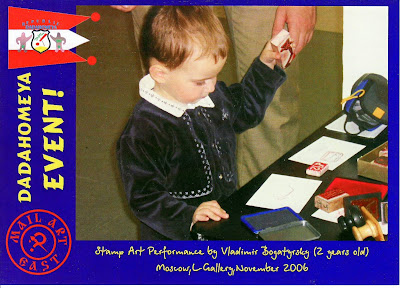
Fierens’s workshop has been followed by similar projects in Germany, France, the Netherlands, and Belgium (“Maanschim--Exploring the Dark and Clear Side of the Moon,” that was independently curated by the children themselves), in which I had the pleasure to participate (see above image), sometimes with my son Luca. In some cases, the children opted to use the alter-and-return system, by sending out art to people who had previously agreed to collaborate and getting their altered works back a few weeks later.
For more information, tips on how to organize a children’s project, etc. you can contact Luc Fierens: Galgenberg 18, 1982 Weerde BELGIUM.

The international mail art network has always been divided between those who like to
chronicle and/or analyze what they do and those who only want to make art and correspond with their friends without having to explain how and why they do what they do. Since the beginning, I have belonged to the former group, even though I understand that too much talking sometimes takes the joy out of the mail art experience. I have recently realized, by the way, that the more I write about mail art, the less I seem to actually do it. In this respect, the last two years have been very slow production-wise. But I digress.
Those who like to talk and write about mail art are a rather small group, if compared to the total of practitioners (they are mostly men, by the way. It seems that women could not care less about these endless debates) but they argue constantly, through their articles and by joining newsgroups, mailing lists and message boards on the Internet. Since 1986 they have even organized, every six years, so-called Decentralized Networker Congresses all over Europe and North America, in order to actually meet and discuss things further. Last year the fourth round of such meetings took place, ranging from informal visits to friends and improvised dinners to big festivals with plenty of events and activities. The one organized by Peter Kuestermann and Angela Pahler (a.k.a. the Netmails) in Minden, Germany was particularly important and attracted many people. One of the topics that were discussed in that occasion was “the future of mail art,” or as some of the participants put it, “is mail art getting old?” or worse yet, “is mail art dying?” What seems to be true is that mail artists are getting old - especially the hardcore group that has embraced mail art as a life style. Several of the people who were in Minden wrote me that “you always see the same faces.” They complain that young people are not interested in this old-fashioned way to network and spend all their time in front of a computer screen or pushing frenetically the keys in their cell phones. Other people reply to these complaints that the mail artists themselves are to blame: We don’t do enough to attract outsiders and make them understand and enjoy the pleasures of mail arting.
One of the more vocal critics of this “ghetto mentality” is Belgian networker Luc Fierens. As he wrote in a recent e-mail, “yes, I feel some of the network has become a closed club of blah-blah news groups and private parties. Wake up and open the field!” Always one who backs his words with facts, Fierens and partner Annina Van Sebroeck started in 1999 a workshop for children aged 8 to 11. Working in collaboration with regional integration center Foyer, they gathered a number of elementary school students, especially belonging to socially disadvantaged groups and immigrant families. At the same time, the work done between October 1999 and February 2000 in weekly meetings was linked to the international mail art network, so that the drawings, paintings, collages, stamps, etc. made during those sessions were sent out and exchanged with artists and children abroad. Thanks to the help of another Belgian networker, Guido Vermeulen, they even managed to involve the American “Children’s Art Program” of kidscommons, a children’s museum in Columbus, Indiana. As Fierens says, “Mail art is communication art. The value of communicating prevails over the artistic value and stands above the classical knowledge of language. This is particularly important for children with language problems. Therefore the aim of this project was to offer real opportunities to communicate across all borders.” The experience was so satisfying that it was repeated four years in a row, every time with a different theme: “Living in the Mirror,” “Dance of Life,” Soul Food: Envelope Your World,” and “Play.” Instrumental to the success of the project were Fierens’s efforts to involve public institutions (something other mail artists are usually not very happy to do) such as the Queen Paola Foundation. The finished works were exhibited at the Central Post Office in Brussels, the Museum of Spontaneous Arts, Molenbeek, the gallery of the public library in Etterbeek, and the Ministry of the French Community, Brussels. Of course achieving open and permanent lines of communication between the children themselves remains difficult, especially across international borders, because the extended waiting period causes them to forget about it and dropout. Nevertheless, receiving mail from another part of the world is a great, unforgettable experience that has a positive influence on their creativity and the way they think about other cultures. Once the seeds of communication are planted, they continue to grow and flourish.
Fierens’s workshop has been followed by similar projects in Germany, France, the Netherlands, and Belgium (“Maanschim--Exploring the Dark and Clear Side of the Moon,” that was independently curated by the children themselves), in which I had the pleasure to participate (see above image), sometimes with my son Luca. In some cases, the children opted to use the alter-and-return system, by sending out art to people who had previously agreed to collaborate and getting their altered works back a few weeks later.
For more information, tips on how to organize a children’s project, etc. you can contact Luc Fierens: Galgenberg 18, 1982 Weerde BELGIUM.

Cultural Terrorism
This is the back of an envelope I received from David Dellafiora, the indefatigable British networker who for several years has been plotting from Australia.

This is the back of an envelope I received from David Dellafiora, the indefatigable British networker who for several years has been plotting from Australia.

I confess I felt a little proud when I saw the "security checked" stamp, and that they had actually opened the envelope to verify its contents: To me it was as if officialdom had once again acknowledged mail art's outsider position as art's weird relative who must be kept in check.
Yes I know this is only wishful thinking.
Well, whatever.
Happy New Year!
For some obscure reason, being timely doesn't seem to be among my qualities. Therefore you will forgive me if I show these two fine pieces of mail only now - more than two months after the start of the new year.
As the people who have followed this blog from the start already know, I don't usually show all the mail I get. There are already too many people who do this. I don't think this is the best or even the most interesting way to use a blog, and to tell you the truth, I find such sites a little boring (even though I can see their "educational" value). But I degress.
I'm showing this beautiful greeting card from Ivan Zemtsov because he post it on January 5th, and arrived in Japan a few days ago. Not bad.
For some obscure reason, being timely doesn't seem to be among my qualities. Therefore you will forgive me if I show these two fine pieces of mail only now - more than two months after the start of the new year.
As the people who have followed this blog from the start already know, I don't usually show all the mail I get. There are already too many people who do this. I don't think this is the best or even the most interesting way to use a blog, and to tell you the truth, I find such sites a little boring (even though I can see their "educational" value). But I degress.
I'm showing this beautiful greeting card from Ivan Zemtsov because he post it on January 5th, and arrived in Japan a few days ago. Not bad.

Also, I want to take this opportunity to thank all the people who send me xmas greetings. Alas, I never do it. I know, I'm a heartless bastard. I don't like xmas and other such festivities, and I'm not interested in celebrating. But I do appreciate your cards, etc. especially when they are as good-looking and witty as the one Keith Bates sent me last year.
 Among the others, I'd like to remember Carol Stetser and Dietmar Vollmer who every year come up this new original ways to brighten my mail box.
2,000 Staples
A few months ago I finally used the last few staples left in the box pictured below.

A few months ago I finally used the last few staples left in the box pictured below.

This makes 2,000 staples in nine years. It might not be a record, but in these last nine years my faithful long-arm stapler has helped me publishing 13 issues of KAIRAN - Mail Art Forum, three issues each of Call & Response and Orga{ni}sm plus several one-shot zines, mail art catalogues, etc.
I think I'm allowed to a little celebration, right?
Monday, January 12, 2009
Tourism (1)

 When I managed to unravel the cleverly assembled combo, I found a bunch of nice envelopes she had made the night before in her hotel room by using paper she had picked up around Tokyo. I told you the girl is crazy.
Because of "family issues," I don't have the chance to travel freely around the world and show up unannounced at the door of unsuspecting mail art friends (do not worry Keith!). That's why I'm very happy every time someone has enough balls (and money) to come all the way to Japan. One lady I'm particularly fond of is Jennie Hinchcliff of Red Letter Day zine and PodPost fame (the latter one is the dynamic duo she has started with partner-in-crime Carolee Gilligam Wheeler). Jennie-chan has an unhealthy passion for all things Japanese, and I've already had a chance to meet her in Tokyo not once but twice. In the photo below we are with her beau in front of Au Temps Jadis, a wonderful creperie in Shibuya (please note the fake European facade).
Every time we meet, Jennie never fails to bring some wonderfully weird present. This is a cute package she gave me the first time we met ("hajimemashite" means "nice to meet you").
When I managed to unravel the cleverly assembled combo, I found a bunch of nice envelopes she had made the night before in her hotel room by using paper she had picked up around Tokyo. I told you the girl is crazy.  Once in a while, she drags Carolee to Japan, and instead of taking it easy and visiting some nice museum, the two magpies roam the streets of Tokyo in search of used tickets, flyers, photos, cute-looking paper and other useful junk they later feature in their zines. This one is called Kimagure na dowa no hon.

If you want to have a look inside, you can check their wonderful web site out at http://www.podpodpost.com/shop.html You'll find many more delights.
Tuesday, December 30, 2008
Showing Off
Mail art is based, among other things, on so-called 'gift culture.' In other words, most mail artists refuse the commercial side of art and prefer instead to send each other their own creations as gifts - which, admittedly, is not a difficult thing to do as our exchanges are based on friendship, not money or interest.
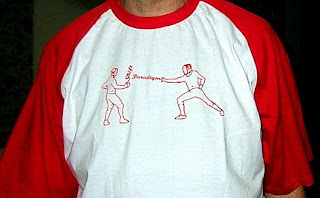
Speaking of friends, the t-shirt in the photo was sent to me by my dear amigo Joan Puig aka John Mountain from Barcelona. JOMO is a relatively recent addition to the mail art network, but he is very well regarded for the quality of his correspondence and his intellectual and artistic works. Actually he is not widely known, for the simple reason that he prefers to cultivate a small personal network of close friends whom he likes to spoil with unique gifts. Like this very limited production t-shirt that features his latest obsession: finding a new paradigm shift to save the world of (mail) art from its current condition. I don't really know how to contribute to his mad quest, but at the very least I can show off his precious gift.
Mail art is based, among other things, on so-called 'gift culture.' In other words, most mail artists refuse the commercial side of art and prefer instead to send each other their own creations as gifts - which, admittedly, is not a difficult thing to do as our exchanges are based on friendship, not money or interest.
Speaking of friends, the t-shirt in the photo was sent to me by my dear amigo Joan Puig aka John Mountain from Barcelona. JOMO is a relatively recent addition to the mail art network, but he is very well regarded for the quality of his correspondence and his intellectual and artistic works. Actually he is not widely known, for the simple reason that he prefers to cultivate a small personal network of close friends whom he likes to spoil with unique gifts. Like this very limited production t-shirt that features his latest obsession: finding a new paradigm shift to save the world of (mail) art from its current condition. I don't really know how to contribute to his mad quest, but at the very least I can show off his precious gift.
Sunday, February 10, 2008
In the world of contemporary art, everybody only seems interested in talking about marketability, auctions and the rising price of paintings. Long cherished words such as “creativity” and “self-expression” have been replaced by the new catchphrase: “art = investment.” And yet there are still people who reject the dog-eat-dog attitude of most professional artists and emphasize instead the communicative, collaborative aspect of the artistic practice. I’m talking of course of the international mail art network that for almost 50 years has mostly flied under the radar of the art establishment. While in the art world everything seems to have a price, mail artists embrace trading and gift culture. And while the pompous rites of the art with a capital $ are consumed in ever bigger, cathedral-like museums, the mail artists are satisfied with much more modest, intimate spaces. Among them, one of the more peculiar and interesting “places” is the Museum of Temporary Art (MoTA) that you can find… in the living room of Benjamin and Debby Böhm in Tubingen, Germany.

“The idea for the museum was born by chance in 2000,” Benjamin explains, “when I found in a supermarket a 50 x 40 x 10 cm box with 33 small drawers that immediately reminded me of those Fluxus kits from the 60s, and decided to give it to Debby as a birthday present.” Debby suggested they may use it as a “guestbook” – visitors could take something from the box and replace it with something they carried on them. But that was only the first step: Benjamin’s other great love is Dada – the European group of anti-art terrorists who at the beginning of the 20th century turned many traditional artistic assumptions on their head – and their playful, iconoclastic attitude. So he proposed to turn it into a full-fledged museum, with a director (Debby), its logo, rubberstamps and other museum-related paraphernalia.

Then they decided to go global and started posting calls in the Internet, making this an ongoing project. As Benjamin explains, “anybody is invited to send us a contribution – by mail, of course. There are no juries and everything is accepted, in typical mail art fashion. The only condition is that the object cannot be bigger than 4 x 4 x 8 cm – otherwise it wouldn’t fit into the drawer. “Also,” adds Benjamin, “don’t forget to send along the exhibition sheet that everybody can download from the museum’s Web site http://www.museum-of-temporary-art.com/, because the stories behind the objects are as important as the objects themselves.” The MoTA’s collection currently amounts to nearly 800 pieces (they are thinking of organizing a great retrospective exhibition when they reach 1000) and includes both traditional artworks and found objects that remind us of the infamous Marcel Duchamp’s “ready mades.” “Most of the contributions,” Debby points out, “are linked to a memory or a particular occurrence. This gives them a special value, and that is what we love about the whole project.”

The MoTA, of course, can house only 33 exhibits at a time (hence the term “temporary art”). This means that every time a new contribution arrives in the mail, the oldest one is replaced (on the Web site, you can always have a look at what currently is in the museum, together with all the descriptions). So what happens to all the pieces after they have had their 15 minutes of “fame”? Debby reassures us that “we don’t sell them but keep the whole lot in our archive.” Like most people who are active in the mail art network, they are not professional artists (Benjamin is a computer programmer; Debby works for a book publisher). They are into it only because they like it, and the MoTA can be considered a labor of love. They are always open to collaboration and welcome anybody, regardless of his or her artistic skill. To contribute to the project, you only have to send something (you can check out the Web site for inspiration) together with the exhibit sheet (please write in English or German) to the following address: Museum of Temporary Art, c/o Debby Böhm, Lange Gasse 25, 72070 Tübingen, Germany. In exchange you will receive a copy of your exhibit sheet and one of the object your contribution has replaced. Not only that, once every 100 exhibits, they send to all the participants a beautiful full-color catalogue (I just found one in my mail box). All this, of course, is for free, in the best mail art tradition. Have fun!
Sunday, July 15, 2007
,Mail Art and Politics
One thing tha many mail artist always like to stress when talking about their activities (although many others don't seem to agree) is that the communicative aspect is far more important than art for art’s sake, and collaboration is one of the key words in the Network, whose ultimate goal is building a sort of alternative approach to culture. This is a practice that the advent of the Internet has amplified to enormous proportions. All these different but often overlapping networks share many strategies and the common principle that “if the Establishment ignores us, we can easily do without it.”
One notable consequence of this approach is that many mail artists are socially and/or politically committed and strive to include these issues in their activity. Here are two examples of the innumerable projects that are constantly being organised. Both of them where started by me (you will excuse me for showing off a little bit …).
Fighting Back - Stop Violence against Women was born because I’m a member of Amnesty International, the worldwide voluntary activist movement working for human rights. At the end of every year, AI Japan reports on its state of health, and the recurring theme in recent years has been that we are constantly losing members and in this country, AI has become more or less an invisible entity. So we felt the need to enhance our public image, trying, in the process, to lure more people into our ranks.

When another member pointed out that the 2004-2006 worldwide campaign would have focused on domestic violence against women, as well as violence in conflict and post conflict, we decided to ask mail artists for help. This, by the way, is by no means the first time that AI and the Network have joined hands to address specific problems (other topics tackled in the past have been torture and the death penalty). A task group was formed, with me concentrating on the mail art part of the project (writing the call, spreading the word, and instructing the others on how to collect and catalogue the incoming works) while other people looked for a suitable venue for the exhibition, invited experts and activists to talk, and organised other collateral activities.


All in all we were able to gather more than 250 contributions from all over the world, including postcards, collages, drawings, photographs, etc, and even local artists, who usually are not active in the mail art network, lent or donated paintings, sculptures and embroidery. The show was a huge success and it travelled to several cities.
Now that this part of the project is over, we are left with hundreds of copies of the catalogue. This is a beautiful, full-color, full-sized 24 page booklet, printed on glossy paper, containing a wide range of the works received, plus brief introductions to Amnesty International, mail art and the theme of the exhibition. If you are interested in visual arts and/or violence against women, or you simply want to help AI Japan to recover at least a part of the expenses, please contact me (jb64jp@yahoo.co.jp) One copy costs $5 to $7 on a sliding scale, postpaid worldwide. Please pay what you can afford and remember that it’s for a just cause.
Mail artists usually interact either by participating in big international exhibitions or on a one-to-one basis. The AI project was an example of the first type. The next project I’d like to describe belongs to the second and is a perfect example of what I like most in mail art: the many possibilities to collaborate and interact with a wide network of like-minded people.
It all started in 1998, when – as a contribution to Vittore Baroni’s Year of Incongruous Meetings – I made a couple of fake election campaign posters (it was election time in Japan) and briefly put them on the same billboard near my house where all the local candidates had put their ugly faces. The idea behind this action was that political elections have become a farce and are almost useless to really change society. It’s a rat race in which every candidate only aims at joining the elite and share power and money. The election posters they make in Japan are particularly cheesy and phoney and you can often see the horrible truth behind the candidates’ smiling masks. After that isolated performance, I decided to start a project, that I called The True Face of Politics, in which I invited some of my friends to make and send me their posters. I collected several works, but once it came to put them on the billboards, I realised I couldn’t do everything by myself, and the people who had offered to help, suddenly became unavailable. I can’t really blame them: after all, what I wanted to do was illegal, and to challenge authority while you live in a foreign country isn’t really a sane thing to do.
This way, the project became a sleeper, and has been kept on hold until now. A couple of years ago I finally found the time and energy to start working on it again, and was lucky to find a group of networkers who were all too happy to collaborate. So I made copies of the posters and sent them to Australia, China, Uruguay, and the US, where each one of my friends did what he or she wanted (or could do: the Shanghai part of the project was for obvious reasons a more private/secret thing).
When everything was over, my collaborators sent me the documentation they had produced (reports, photos, etc.) and now I’m finally putting everything together and producing the final doc, that will be included in my zine KAIRAN. Let me know if you want to order a copy of the forthcoming issue #13.
One thing tha many mail artist always like to stress when talking about their activities (although many others don't seem to agree) is that the communicative aspect is far more important than art for art’s sake, and collaboration is one of the key words in the Network, whose ultimate goal is building a sort of alternative approach to culture. This is a practice that the advent of the Internet has amplified to enormous proportions. All these different but often overlapping networks share many strategies and the common principle that “if the Establishment ignores us, we can easily do without it.”
One notable consequence of this approach is that many mail artists are socially and/or politically committed and strive to include these issues in their activity. Here are two examples of the innumerable projects that are constantly being organised. Both of them where started by me (you will excuse me for showing off a little bit …).
Fighting Back - Stop Violence against Women was born because I’m a member of Amnesty International, the worldwide voluntary activist movement working for human rights. At the end of every year, AI Japan reports on its state of health, and the recurring theme in recent years has been that we are constantly losing members and in this country, AI has become more or less an invisible entity. So we felt the need to enhance our public image, trying, in the process, to lure more people into our ranks.
When another member pointed out that the 2004-2006 worldwide campaign would have focused on domestic violence against women, as well as violence in conflict and post conflict, we decided to ask mail artists for help. This, by the way, is by no means the first time that AI and the Network have joined hands to address specific problems (other topics tackled in the past have been torture and the death penalty). A task group was formed, with me concentrating on the mail art part of the project (writing the call, spreading the word, and instructing the others on how to collect and catalogue the incoming works) while other people looked for a suitable venue for the exhibition, invited experts and activists to talk, and organised other collateral activities.


All in all we were able to gather more than 250 contributions from all over the world, including postcards, collages, drawings, photographs, etc, and even local artists, who usually are not active in the mail art network, lent or donated paintings, sculptures and embroidery. The show was a huge success and it travelled to several cities.
Now that this part of the project is over, we are left with hundreds of copies of the catalogue. This is a beautiful, full-color, full-sized 24 page booklet, printed on glossy paper, containing a wide range of the works received, plus brief introductions to Amnesty International, mail art and the theme of the exhibition. If you are interested in visual arts and/or violence against women, or you simply want to help AI Japan to recover at least a part of the expenses, please contact me (jb64jp@yahoo.co.jp) One copy costs $5 to $7 on a sliding scale, postpaid worldwide. Please pay what you can afford and remember that it’s for a just cause.
Mail artists usually interact either by participating in big international exhibitions or on a one-to-one basis. The AI project was an example of the first type. The next project I’d like to describe belongs to the second and is a perfect example of what I like most in mail art: the many possibilities to collaborate and interact with a wide network of like-minded people.
It all started in 1998, when – as a contribution to Vittore Baroni’s Year of Incongruous Meetings – I made a couple of fake election campaign posters (it was election time in Japan) and briefly put them on the same billboard near my house where all the local candidates had put their ugly faces. The idea behind this action was that political elections have become a farce and are almost useless to really change society. It’s a rat race in which every candidate only aims at joining the elite and share power and money. The election posters they make in Japan are particularly cheesy and phoney and you can often see the horrible truth behind the candidates’ smiling masks. After that isolated performance, I decided to start a project, that I called The True Face of Politics, in which I invited some of my friends to make and send me their posters. I collected several works, but once it came to put them on the billboards, I realised I couldn’t do everything by myself, and the people who had offered to help, suddenly became unavailable. I can’t really blame them: after all, what I wanted to do was illegal, and to challenge authority while you live in a foreign country isn’t really a sane thing to do.
This way, the project became a sleeper, and has been kept on hold until now. A couple of years ago I finally found the time and energy to start working on it again, and was lucky to find a group of networkers who were all too happy to collaborate. So I made copies of the posters and sent them to Australia, China, Uruguay, and the US, where each one of my friends did what he or she wanted (or could do: the Shanghai part of the project was for obvious reasons a more private/secret thing).
When everything was over, my collaborators sent me the documentation they had produced (reports, photos, etc.) and now I’m finally putting everything together and producing the final doc, that will be included in my zine KAIRAN. Let me know if you want to order a copy of the forthcoming issue #13.
Do you like horror stories? Lately I find it increasingly difficult to find good ones, especially when it comes to movies. It seems that coming up with engaging, original plots is getting harder and harder. Even so called J-Horror (the recent new wave of films from Japan that became popular worldwide thanks to The Ring has reached a cul-de-sac. Oddly enough, some of the people who have recently provided me with the best bad vibes are sound artists…
Take, for example, Mark Sonnenfeld. Many of you should at least know his name because his booklets are often reviewed in a number of zine review zines. Mark has been very active in the mail art and experimental poetry circuits for many years now, but I recently discovered a new side of his creativity, when I found in my mailbox Experimental Tape New Jersey #2 that he produced together with the mysterious Ghostly Bus. ETNJ#2 is a slow-burning piece of suspense. Mark & GB avoid any loud noise, instead insinuating themselves into your ears with muffled sounds, strange voices, ringing telephones, and a robotik funk riff. This tape was the ideal soundtrack while reading the truly dreadful Gerald’s Game by Stephen King, one of the few writers who can still make the hair on my neck stand.

The never-resting Sonnenfeld even collaborated with Ken Miller, another mail artist who likes to play (with) music. Miller added a catchy bass riff to a street recording of Mark’s A Red Shirted No Friends. The quiet main theme blends wonderfully with Mark’s plain recitation. Only in the mid-section things go a little crazy, when Ken juxtaposes two different vocal tracks and starts experimenting with music, but always in a very soft way.


Take, for example, Mark Sonnenfeld. Many of you should at least know his name because his booklets are often reviewed in a number of zine review zines. Mark has been very active in the mail art and experimental poetry circuits for many years now, but I recently discovered a new side of his creativity, when I found in my mailbox Experimental Tape New Jersey #2 that he produced together with the mysterious Ghostly Bus. ETNJ#2 is a slow-burning piece of suspense. Mark & GB avoid any loud noise, instead insinuating themselves into your ears with muffled sounds, strange voices, ringing telephones, and a robotik funk riff. This tape was the ideal soundtrack while reading the truly dreadful Gerald’s Game by Stephen King, one of the few writers who can still make the hair on my neck stand.

The never-resting Sonnenfeld even collaborated with Ken Miller, another mail artist who likes to play (with) music. Miller added a catchy bass riff to a street recording of Mark’s A Red Shirted No Friends. The quiet main theme blends wonderfully with Mark’s plain recitation. Only in the mid-section things go a little crazy, when Ken juxtaposes two different vocal tracks and starts experimenting with music, but always in a very soft way.

Miller’s usual stomping ground, though, is his almost one-man-band SinDex Industries – formerly (un)known as Sinister Dexter – through which he explores and sometimes abuses American musical tradition. Particularly good is the anthology Fifteen Years (1984-1999) in which you will find, among other things, weird blues songs; rock songs whose lyrics were pulled at random from a car repair manual; a couple of more atmospheric tracks; great versions of Beatles and Clash songs; and an effect of Ken’s invention called “Miracle Earache” which according to Mr. Miller, “along with producing the worst feedback imaginable, picks up several channels of AM radio. The album’s notes, by the way, are as hilarious and good as the music.
As every horror fan knows very well, the best stories often are the ones that deal with everyday life and ordinary people. In this sense one of the best recent projects I stumbled upon is the Quotidian Assemblages 3-CD series edited and produced by Hal McGee.
As every horror fan knows very well, the best stories often are the ones that deal with everyday life and ordinary people. In this sense one of the best recent projects I stumbled upon is the Quotidian Assemblages 3-CD series edited and produced by Hal McGee.

For those who don’t know him, Hal is a senior member of the huge D.I.Y. tape network that originated in the 70s and developed worldwide with more than a few contacts with the mail art community. Hal had the brilliant idea to invite a wild bunch of Mad Professors to create audio works based upon ordinary everyday sounds. Loren Steele, for example, shows you how a not-well-oiled window can upset your nerves. G..X. Jupitter-Larsen's plain field recording of the Paris metro acquires new sinister tones after the terrorist London bombings. Mystified’s “Pan Pan Pot Spoon” is all in its title, but the overall effect is as spooky as a Tibetan thriller. And then you have evil washing machines, undigested breakfasts, dog-walking gone wrong, apocalyptic radio news…
Perpetually house-moving mail artist and poet Jessy Kendall is another person who likes all-round playing. As Marcel Herms wrote in the third issue of his excellent zine Rigodon regarding Jessy’s CD Rough Ride of Crafts, “It’s always a good thing when you can’t immediately pigeonhole a record. Like this one.” Jessy uses a bunch of fairly conventional instruments on his release, but the end result is quite unconventional – not as creepy as I would like though… It jumps from voice-experiments to a synth-bass-based psychedelic jam to some weird loops. But its experimentation is always soft, and quite entertaining.


Perpetually house-moving mail artist and poet Jessy Kendall is another person who likes all-round playing. As Marcel Herms wrote in the third issue of his excellent zine Rigodon regarding Jessy’s CD Rough Ride of Crafts, “It’s always a good thing when you can’t immediately pigeonhole a record. Like this one.” Jessy uses a bunch of fairly conventional instruments on his release, but the end result is quite unconventional – not as creepy as I would like though… It jumps from voice-experiments to a synth-bass-based psychedelic jam to some weird loops. But its experimentation is always soft, and quite entertaining.


Among other things, Jessy publishes a couple of interesting zines: a monthly collection of his poems and Answer Shirker, which features other people’s works, some in color [above left you can see a collaborative work he made with Jim Leftwich). His letters are very interesting too.
When not working on Rigodon (US$ 7.00) (a publication mostly devoted to noise & experimental music), Herms himself loves to torture your ears and brain with his usually very loud productions. Check them out at your own risk.
When not working on Rigodon (US$ 7.00) (a publication mostly devoted to noise & experimental music), Herms himself loves to torture your ears and brain with his usually very loud productions. Check them out at your own risk.
As I mentioned earlier, you don’t have to escape into the realm of ghosts and monsters to get your daily dose of horror. In this respect, the best CD that recently found its way into my mailbox is without doubt Franetta McMillian’s Reveries of the Solitary Walker (US$ 10.00).

Among these very well produced songs (actually more poetry with music) you will find scathing condemnations of past and current American politics, and of contemporary society; a sad, moving tale of domestic violence; a clever send-off of fanaticism, fundamentalism and terrorism; and a piece that could be defined as pro-euthanasia (see below). Actually there is much, much more in this excellent album, including seven instrumentals, and not everything is as bleak as I make it sound. Indeed, the overall mood is one of hope.


Okay, back to the classics, let me mention quickly a tape I made some time ago. The Overlook is a reworking of The Shining (yes, King again). A friend of mine recorded excerpts from the novel, which I mixed with old music from my own collection – nothing original – mostly alternative rock (e.g. Cassiber and Art Bears) and other strange music (Pierre Henry, Negativeland). It’s quite rough around the aural edges, but all in all it’s satisfyingly dark. If you want to give it a try, send me US$ 4.00 or an equivalent trade.
Thank you and good night.

Mark Sonnenfeld, 45-08 Old Millstone Drive, East Windsor, NJ 08520, USA
Ken Miller, P.O. Box, 101, Newtown, PA 18940-0101, USA <kenbmiller@gmail.com> <www.kenbmiller.com/satpostman>
Hal McGee, 1909E SW 42 Way, Gainesville, FL 32607, USA <Haltapes1@aol.com> <http://www.halmcgee.com/>


Okay, back to the classics, let me mention quickly a tape I made some time ago. The Overlook is a reworking of The Shining (yes, King again). A friend of mine recorded excerpts from the novel, which I mixed with old music from my own collection – nothing original – mostly alternative rock (e.g. Cassiber and Art Bears) and other strange music (Pierre Henry, Negativeland). It’s quite rough around the aural edges, but all in all it’s satisfyingly dark. If you want to give it a try, send me US$ 4.00 or an equivalent trade.
Thank you and good night.

Mark Sonnenfeld, 45-08 Old Millstone Drive, East Windsor, NJ 08520, USA
Ken Miller, P.O. Box, 101, Newtown, PA 18940-0101, USA <kenbmiller@gmail.com> <www.kenbmiller.com/satpostman>
Hal McGee, 1909E SW 42 Way, Gainesville, FL 32607, USA <Haltapes1@aol.com> <http://www.halmcgee.com/>
Jessy Kendall, shirk@riseup.net
Marcel Herms, Postbus 6359, 7401 JJ Deventer, The Netherlands mherms@home.nl
Franetta McMillian, PMB 170, 40 E. Main St, Newark, DE 19711 marybld@aol.com
Gianni Simone, 3-3-23 Nagatsuta, Midori-ku, Yokohama-shi, 226-0027 Kanagawa-ken, Japan jb64jp@yahoo.co.jp
Marcel Herms, Postbus 6359, 7401 JJ Deventer, The Netherlands mherms@home.nl
Franetta McMillian, PMB 170, 40 E. Main St, Newark, DE 19711 marybld@aol.com
Gianni Simone, 3-3-23 Nagatsuta, Midori-ku, Yokohama-shi, 226-0027 Kanagawa-ken, Japan jb64jp@yahoo.co.jp
Wednesday, June 14, 2006
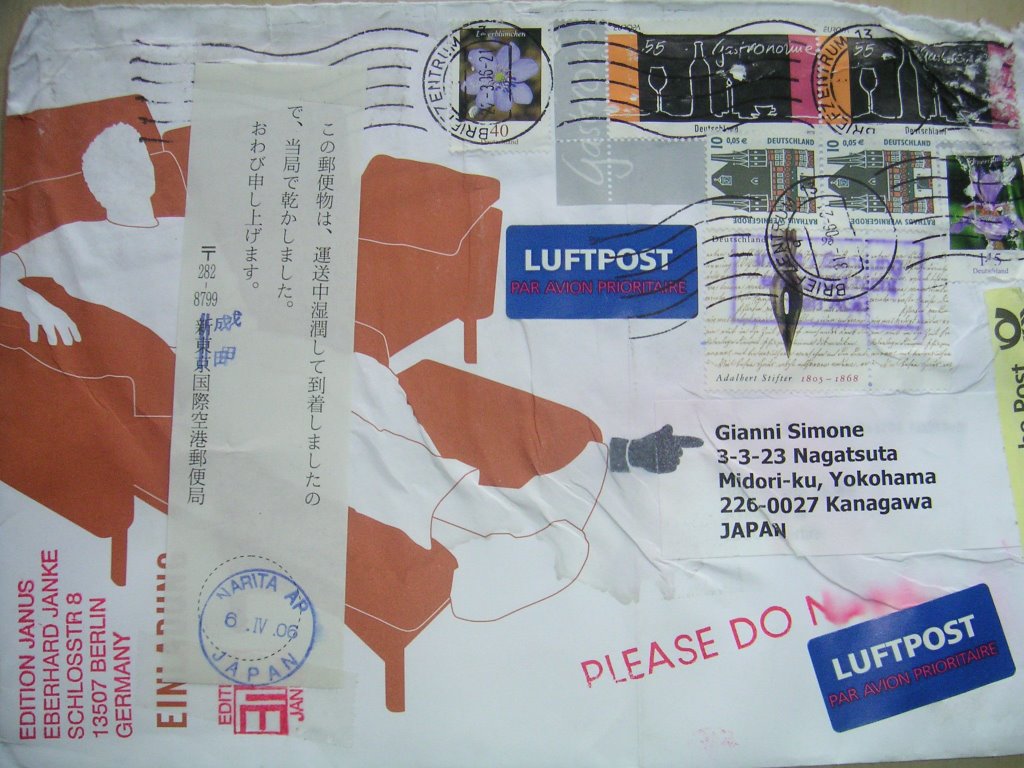 Yes, Sundays can be really gloomy. Or at least they used to be. Lately I manage to somewhat control myself - especially if the day before has been a good catch... Well, actually I should not complain about the postal service here: Japan is, in many respects, a paradise for all the lovers of the good ole (some say obsolete) art of letter writing. They always deliver the goods no matter what. Even if the sender has not put enough postage, the guys in green leave your mail in your box, of course adding a note in which they politely ask you to please go to the nearest post office and pay the difference (in Italy, il postino mafioso usually threatens to eat your letter in front of you if you don't pay on the spot). Rain, typhoons or earthquakes will never stop mail here. On the right you can see an envelope I got from German mail wunder-artist Eberhard Janke (of Edition Janus fame). For some reason it got completely wet before it could reach my house. On the left side you can see a brief not of apologies from the P.O. If you don't forgive them, they proceed to commit hara-kiri, like John Belushi's samurai in Saturday Night Live. Actually the accident caused the rubberstamp prints enclosed to bleed into each other, thus creating very interesting visual effects. Here's a nice example of chance collaboration between the artist and the postal service.
.0.jpg) On the other side of satisfaction - and of the Pacific - we find the truly evil postal clerks of Baltimore, USA. Look what they did to the poor envelope on the left. It all started because I wrote the name of a zine - Leeking Ink - instead of the one of its editrix - Davida Gypsy Breier. That was enough for them to return it to me. So I decided to try again, but I don't like to do things the easy way, so I re-used the returned envelope, this time writing the right name AND the nice note you can see on the left side: "Dear Mr/Ms Postman, THIS is the right address. Thank you in advance for your cooperation." The ever kind people at the Japanese post office were worried that all those stamps and symbols would create some confusion, so they crossed the "return to sender" stamp, and wrote "to USA" with a black marker. But to no avail: after a few weeks, the doomed envelope reappeared inside my mail box. I've decided to add it to my collection of weird mail...
On the other side of satisfaction - and of the Pacific - we find the truly evil postal clerks of Baltimore, USA. Look what they did to the poor envelope on the left. It all started because I wrote the name of a zine - Leeking Ink - instead of the one of its editrix - Davida Gypsy Breier. That was enough for them to return it to me. So I decided to try again, but I don't like to do things the easy way, so I re-used the returned envelope, this time writing the right name AND the nice note you can see on the left side: "Dear Mr/Ms Postman, THIS is the right address. Thank you in advance for your cooperation." The ever kind people at the Japanese post office were worried that all those stamps and symbols would create some confusion, so they crossed the "return to sender" stamp, and wrote "to USA" with a black marker. But to no avail: after a few weeks, the doomed envelope reappeared inside my mail box. I've decided to add it to my collection of weird mail...When you are finished reading this, you'll better check Davida's Web site: http://www.leekinginc.com/
Subscribe to:
Posts (Atom)

 Posts
Posts


