The Future of Mail Art
The international mail art network has always been divided between those who like to
chronicle and/or analyze what they do and those who only want to make art and correspond with their friends without having to explain how and why they do what they do. Since the beginning, I have belonged to the former group, even though I understand that too much talking sometimes takes the joy out of the mail art experience. I have recently realized, by the way, that the more I write about mail art, the less I seem to actually do it. In this respect, the last two years have been very slow production-wise. But I digress.
Those who like to talk and write about mail art are a rather small group, if compared to the total of practitioners (they are mostly men, by the way. It seems that women could not care less about these endless debates) but they argue constantly, through their articles and by joining newsgroups, mailing lists and message boards on the Internet. Since 1986 they have even organized, every six years, so-called Decentralized Networker Congresses all over Europe and North America, in order to actually meet and discuss things further. Last year the fourth round of such meetings took place, ranging from informal visits to friends and improvised dinners to big festivals with plenty of events and activities. The one organized by Peter Kuestermann and Angela Pahler (a.k.a. the Netmails) in Minden, Germany was particularly important and attracted many people. One of the topics that were discussed in that occasion was “the future of mail art,” or as some of the participants put it, “is mail art getting old?” or worse yet, “is mail art dying?” What seems to be true is that mail artists are getting old - especially the hardcore group that has embraced mail art as a life style. Several of the people who were in Minden wrote me that “you always see the same faces.” They complain that young people are not interested in this old-fashioned way to network and spend all their time in front of a computer screen or pushing frenetically the keys in their cell phones. Other people reply to these complaints that the mail artists themselves are to blame: We don’t do enough to attract outsiders and make them understand and enjoy the pleasures of mail arting.
One of the more vocal critics of this “ghetto mentality” is Belgian networker Luc Fierens. As he wrote in a recent e-mail, “yes, I feel some of the network has become a closed club of blah-blah news groups and private parties. Wake up and open the field!” Always one who backs his words with facts, Fierens and partner Annina Van Sebroeck started in 1999 a workshop for children aged 8 to 11. Working in collaboration with regional integration center Foyer, they gathered a number of elementary school students, especially belonging to socially disadvantaged groups and immigrant families. At the same time, the work done between October 1999 and February 2000 in weekly meetings was linked to the international mail art network, so that the drawings, paintings, collages, stamps, etc. made during those sessions were sent out and exchanged with artists and children abroad. Thanks to the help of another Belgian networker, Guido Vermeulen, they even managed to involve the American “Children’s Art Program” of kidscommons, a children’s museum in Columbus, Indiana. As Fierens says, “Mail art is communication art. The value of communicating prevails over the artistic value and stands above the classical knowledge of language. This is particularly important for children with language problems. Therefore the aim of this project was to offer real opportunities to communicate across all borders.” The experience was so satisfying that it was repeated four years in a row, every time with a different theme: “Living in the Mirror,” “Dance of Life,” Soul Food: Envelope Your World,” and “Play.” Instrumental to the success of the project were Fierens’s efforts to involve public institutions (something other mail artists are usually not very happy to do) such as the Queen Paola Foundation. The finished works were exhibited at the Central Post Office in Brussels, the Museum of Spontaneous Arts, Molenbeek, the gallery of the public library in Etterbeek, and the Ministry of the French Community, Brussels. Of course achieving open and permanent lines of communication between the children themselves remains difficult, especially across international borders, because the extended waiting period causes them to forget about it and dropout. Nevertheless, receiving mail from another part of the world is a great, unforgettable experience that has a positive influence on their creativity and the way they think about other cultures. Once the seeds of communication are planted, they continue to grow and flourish.
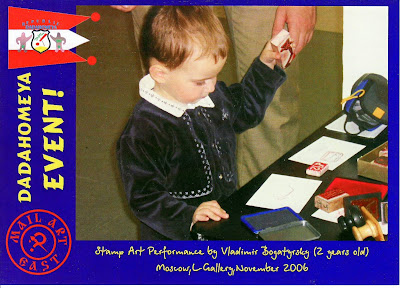
Fierens’s workshop has been followed by similar projects in Germany, France, the Netherlands, and Belgium (“Maanschim--Exploring the Dark and Clear Side of the Moon,” that was independently curated by the children themselves), in which I had the pleasure to participate (see above image), sometimes with my son Luca. In some cases, the children opted to use the alter-and-return system, by sending out art to people who had previously agreed to collaborate and getting their altered works back a few weeks later.
For more information, tips on how to organize a children’s project, etc. you can contact Luc Fierens: Galgenberg 18, 1982 Weerde BELGIUM.




 When I managed to unravel the cleverly assembled combo, I found a bunch of nice envelopes she had made the night before in her hotel room by using paper she had picked up around Tokyo. I told you the girl is crazy.
  Once in a while, she drags Carolee to Japan, and instead of taking it easy and visiting some nice museum, the two magpies roam the streets of Tokyo in search of used tickets, flyers, photos, cute-looking paper and other useful junk they later feature in their zines. This one is called Kimagure na dowa no hon.

 Posts
Posts


