In 1998 I met through the post German mail artist Johannes Musholf. We happened to have a friend in common (not a rare thing in our Network), Ivan Zemtsov from Russia. As our names were different versions of the English 'John' I came up with the idea of forming a collaborative group whose name was supposed to be The Three Johns (anybody remembers the British new wave band of the '80s?). Sadly Johannes suddenly died in 1999. As a tribute to him I've uploaded the last thing he sent me before passing away. Johannes was fond of telling stories, and that was one of the things I liked the most about him.
Showing posts with label Germany. Show all posts
Sunday, March 15, 2009
In Memory of a New Friend
In 1998 I met through the post German mail artist Johannes Musholf. We happened to have a friend in common (not a rare thing in our Network), Ivan Zemtsov from Russia. As our names were different versions of the English 'John' I came up with the idea of forming a collaborative group whose name was supposed to be The Three Johns (anybody remembers the British new wave band of the '80s?). Sadly Johannes suddenly died in 1999. As a tribute to him I've uploaded the last thing he sent me before passing away. Johannes was fond of telling stories, and that was one of the things I liked the most about him.
The Future of Mail Art

The international mail art network has always been divided between those who like to
chronicle and/or analyze what they do and those who only want to make art and correspond with their friends without having to explain how and why they do what they do. Since the beginning, I have belonged to the former group, even though I understand that too much talking sometimes takes the joy out of the mail art experience. I have recently realized, by the way, that the more I write about mail art, the less I seem to actually do it. In this respect, the last two years have been very slow production-wise. But I digress.
Those who like to talk and write about mail art are a rather small group, if compared to the total of practitioners (they are mostly men, by the way. It seems that women could not care less about these endless debates) but they argue constantly, through their articles and by joining newsgroups, mailing lists and message boards on the Internet. Since 1986 they have even organized, every six years, so-called Decentralized Networker Congresses all over Europe and North America, in order to actually meet and discuss things further. Last year the fourth round of such meetings took place, ranging from informal visits to friends and improvised dinners to big festivals with plenty of events and activities. The one organized by Peter Kuestermann and Angela Pahler (a.k.a. the Netmails) in Minden, Germany was particularly important and attracted many people. One of the topics that were discussed in that occasion was “the future of mail art,” or as some of the participants put it, “is mail art getting old?” or worse yet, “is mail art dying?” What seems to be true is that mail artists are getting old - especially the hardcore group that has embraced mail art as a life style. Several of the people who were in Minden wrote me that “you always see the same faces.” They complain that young people are not interested in this old-fashioned way to network and spend all their time in front of a computer screen or pushing frenetically the keys in their cell phones. Other people reply to these complaints that the mail artists themselves are to blame: We don’t do enough to attract outsiders and make them understand and enjoy the pleasures of mail arting.
One of the more vocal critics of this “ghetto mentality” is Belgian networker Luc Fierens. As he wrote in a recent e-mail, “yes, I feel some of the network has become a closed club of blah-blah news groups and private parties. Wake up and open the field!” Always one who backs his words with facts, Fierens and partner Annina Van Sebroeck started in 1999 a workshop for children aged 8 to 11. Working in collaboration with regional integration center Foyer, they gathered a number of elementary school students, especially belonging to socially disadvantaged groups and immigrant families. At the same time, the work done between October 1999 and February 2000 in weekly meetings was linked to the international mail art network, so that the drawings, paintings, collages, stamps, etc. made during those sessions were sent out and exchanged with artists and children abroad. Thanks to the help of another Belgian networker, Guido Vermeulen, they even managed to involve the American “Children’s Art Program” of kidscommons, a children’s museum in Columbus, Indiana. As Fierens says, “Mail art is communication art. The value of communicating prevails over the artistic value and stands above the classical knowledge of language. This is particularly important for children with language problems. Therefore the aim of this project was to offer real opportunities to communicate across all borders.” The experience was so satisfying that it was repeated four years in a row, every time with a different theme: “Living in the Mirror,” “Dance of Life,” Soul Food: Envelope Your World,” and “Play.” Instrumental to the success of the project were Fierens’s efforts to involve public institutions (something other mail artists are usually not very happy to do) such as the Queen Paola Foundation. The finished works were exhibited at the Central Post Office in Brussels, the Museum of Spontaneous Arts, Molenbeek, the gallery of the public library in Etterbeek, and the Ministry of the French Community, Brussels. Of course achieving open and permanent lines of communication between the children themselves remains difficult, especially across international borders, because the extended waiting period causes them to forget about it and dropout. Nevertheless, receiving mail from another part of the world is a great, unforgettable experience that has a positive influence on their creativity and the way they think about other cultures. Once the seeds of communication are planted, they continue to grow and flourish.
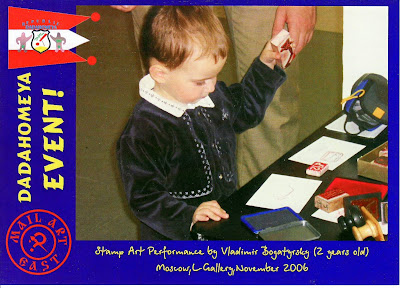
Fierens’s workshop has been followed by similar projects in Germany, France, the Netherlands, and Belgium (“Maanschim--Exploring the Dark and Clear Side of the Moon,” that was independently curated by the children themselves), in which I had the pleasure to participate (see above image), sometimes with my son Luca. In some cases, the children opted to use the alter-and-return system, by sending out art to people who had previously agreed to collaborate and getting their altered works back a few weeks later.
For more information, tips on how to organize a children’s project, etc. you can contact Luc Fierens: Galgenberg 18, 1982 Weerde BELGIUM.
The international mail art network has always been divided between those who like to
chronicle and/or analyze what they do and those who only want to make art and correspond with their friends without having to explain how and why they do what they do. Since the beginning, I have belonged to the former group, even though I understand that too much talking sometimes takes the joy out of the mail art experience. I have recently realized, by the way, that the more I write about mail art, the less I seem to actually do it. In this respect, the last two years have been very slow production-wise. But I digress.
Those who like to talk and write about mail art are a rather small group, if compared to the total of practitioners (they are mostly men, by the way. It seems that women could not care less about these endless debates) but they argue constantly, through their articles and by joining newsgroups, mailing lists and message boards on the Internet. Since 1986 they have even organized, every six years, so-called Decentralized Networker Congresses all over Europe and North America, in order to actually meet and discuss things further. Last year the fourth round of such meetings took place, ranging from informal visits to friends and improvised dinners to big festivals with plenty of events and activities. The one organized by Peter Kuestermann and Angela Pahler (a.k.a. the Netmails) in Minden, Germany was particularly important and attracted many people. One of the topics that were discussed in that occasion was “the future of mail art,” or as some of the participants put it, “is mail art getting old?” or worse yet, “is mail art dying?” What seems to be true is that mail artists are getting old - especially the hardcore group that has embraced mail art as a life style. Several of the people who were in Minden wrote me that “you always see the same faces.” They complain that young people are not interested in this old-fashioned way to network and spend all their time in front of a computer screen or pushing frenetically the keys in their cell phones. Other people reply to these complaints that the mail artists themselves are to blame: We don’t do enough to attract outsiders and make them understand and enjoy the pleasures of mail arting.
One of the more vocal critics of this “ghetto mentality” is Belgian networker Luc Fierens. As he wrote in a recent e-mail, “yes, I feel some of the network has become a closed club of blah-blah news groups and private parties. Wake up and open the field!” Always one who backs his words with facts, Fierens and partner Annina Van Sebroeck started in 1999 a workshop for children aged 8 to 11. Working in collaboration with regional integration center Foyer, they gathered a number of elementary school students, especially belonging to socially disadvantaged groups and immigrant families. At the same time, the work done between October 1999 and February 2000 in weekly meetings was linked to the international mail art network, so that the drawings, paintings, collages, stamps, etc. made during those sessions were sent out and exchanged with artists and children abroad. Thanks to the help of another Belgian networker, Guido Vermeulen, they even managed to involve the American “Children’s Art Program” of kidscommons, a children’s museum in Columbus, Indiana. As Fierens says, “Mail art is communication art. The value of communicating prevails over the artistic value and stands above the classical knowledge of language. This is particularly important for children with language problems. Therefore the aim of this project was to offer real opportunities to communicate across all borders.” The experience was so satisfying that it was repeated four years in a row, every time with a different theme: “Living in the Mirror,” “Dance of Life,” Soul Food: Envelope Your World,” and “Play.” Instrumental to the success of the project were Fierens’s efforts to involve public institutions (something other mail artists are usually not very happy to do) such as the Queen Paola Foundation. The finished works were exhibited at the Central Post Office in Brussels, the Museum of Spontaneous Arts, Molenbeek, the gallery of the public library in Etterbeek, and the Ministry of the French Community, Brussels. Of course achieving open and permanent lines of communication between the children themselves remains difficult, especially across international borders, because the extended waiting period causes them to forget about it and dropout. Nevertheless, receiving mail from another part of the world is a great, unforgettable experience that has a positive influence on their creativity and the way they think about other cultures. Once the seeds of communication are planted, they continue to grow and flourish.
Fierens’s workshop has been followed by similar projects in Germany, France, the Netherlands, and Belgium (“Maanschim--Exploring the Dark and Clear Side of the Moon,” that was independently curated by the children themselves), in which I had the pleasure to participate (see above image), sometimes with my son Luca. In some cases, the children opted to use the alter-and-return system, by sending out art to people who had previously agreed to collaborate and getting their altered works back a few weeks later.
For more information, tips on how to organize a children’s project, etc. you can contact Luc Fierens: Galgenberg 18, 1982 Weerde BELGIUM.
Labels:
Belgium,
Germany,
mail art,
mail art project,
meetings
Sunday, February 10, 2008
In the world of contemporary art, everybody only seems interested in talking about marketability, auctions and the rising price of paintings. Long cherished words such as “creativity” and “self-expression” have been replaced by the new catchphrase: “art = investment.” And yet there are still people who reject the dog-eat-dog attitude of most professional artists and emphasize instead the communicative, collaborative aspect of the artistic practice. I’m talking of course of the international mail art network that for almost 50 years has mostly flied under the radar of the art establishment. While in the art world everything seems to have a price, mail artists embrace trading and gift culture. And while the pompous rites of the art with a capital $ are consumed in ever bigger, cathedral-like museums, the mail artists are satisfied with much more modest, intimate spaces. Among them, one of the more peculiar and interesting “places” is the Museum of Temporary Art (MoTA) that you can find… in the living room of Benjamin and Debby Böhm in Tubingen, Germany.

“The idea for the museum was born by chance in 2000,” Benjamin explains, “when I found in a supermarket a 50 x 40 x 10 cm box with 33 small drawers that immediately reminded me of those Fluxus kits from the 60s, and decided to give it to Debby as a birthday present.” Debby suggested they may use it as a “guestbook” – visitors could take something from the box and replace it with something they carried on them. But that was only the first step: Benjamin’s other great love is Dada – the European group of anti-art terrorists who at the beginning of the 20th century turned many traditional artistic assumptions on their head – and their playful, iconoclastic attitude. So he proposed to turn it into a full-fledged museum, with a director (Debby), its logo, rubberstamps and other museum-related paraphernalia.

Then they decided to go global and started posting calls in the Internet, making this an ongoing project. As Benjamin explains, “anybody is invited to send us a contribution – by mail, of course. There are no juries and everything is accepted, in typical mail art fashion. The only condition is that the object cannot be bigger than 4 x 4 x 8 cm – otherwise it wouldn’t fit into the drawer. “Also,” adds Benjamin, “don’t forget to send along the exhibition sheet that everybody can download from the museum’s Web site http://www.museum-of-temporary-art.com/, because the stories behind the objects are as important as the objects themselves.” The MoTA’s collection currently amounts to nearly 800 pieces (they are thinking of organizing a great retrospective exhibition when they reach 1000) and includes both traditional artworks and found objects that remind us of the infamous Marcel Duchamp’s “ready mades.” “Most of the contributions,” Debby points out, “are linked to a memory or a particular occurrence. This gives them a special value, and that is what we love about the whole project.”
The MoTA, of course, can house only 33 exhibits at a time (hence the term “temporary art”). This means that every time a new contribution arrives in the mail, the oldest one is replaced (on the Web site, you can always have a look at what currently is in the museum, together with all the descriptions). So what happens to all the pieces after they have had their 15 minutes of “fame”? Debby reassures us that “we don’t sell them but keep the whole lot in our archive.” Like most people who are active in the mail art network, they are not professional artists (Benjamin is a computer programmer; Debby works for a book publisher). They are into it only because they like it, and the MoTA can be considered a labor of love. They are always open to collaboration and welcome anybody, regardless of his or her artistic skill. To contribute to the project, you only have to send something (you can check out the Web site for inspiration) together with the exhibit sheet (please write in English or German) to the following address: Museum of Temporary Art, c/o Debby Böhm, Lange Gasse 25, 72070 Tübingen, Germany. In exchange you will receive a copy of your exhibit sheet and one of the object your contribution has replaced. Not only that, once every 100 exhibits, they send to all the participants a beautiful full-color catalogue (I just found one in my mail box). All this, of course, is for free, in the best mail art tradition. Have fun!
Labels:
Germany,
mail art,
mail art catalogue,
mail art project
Subscribe to:
Posts (Atom)